
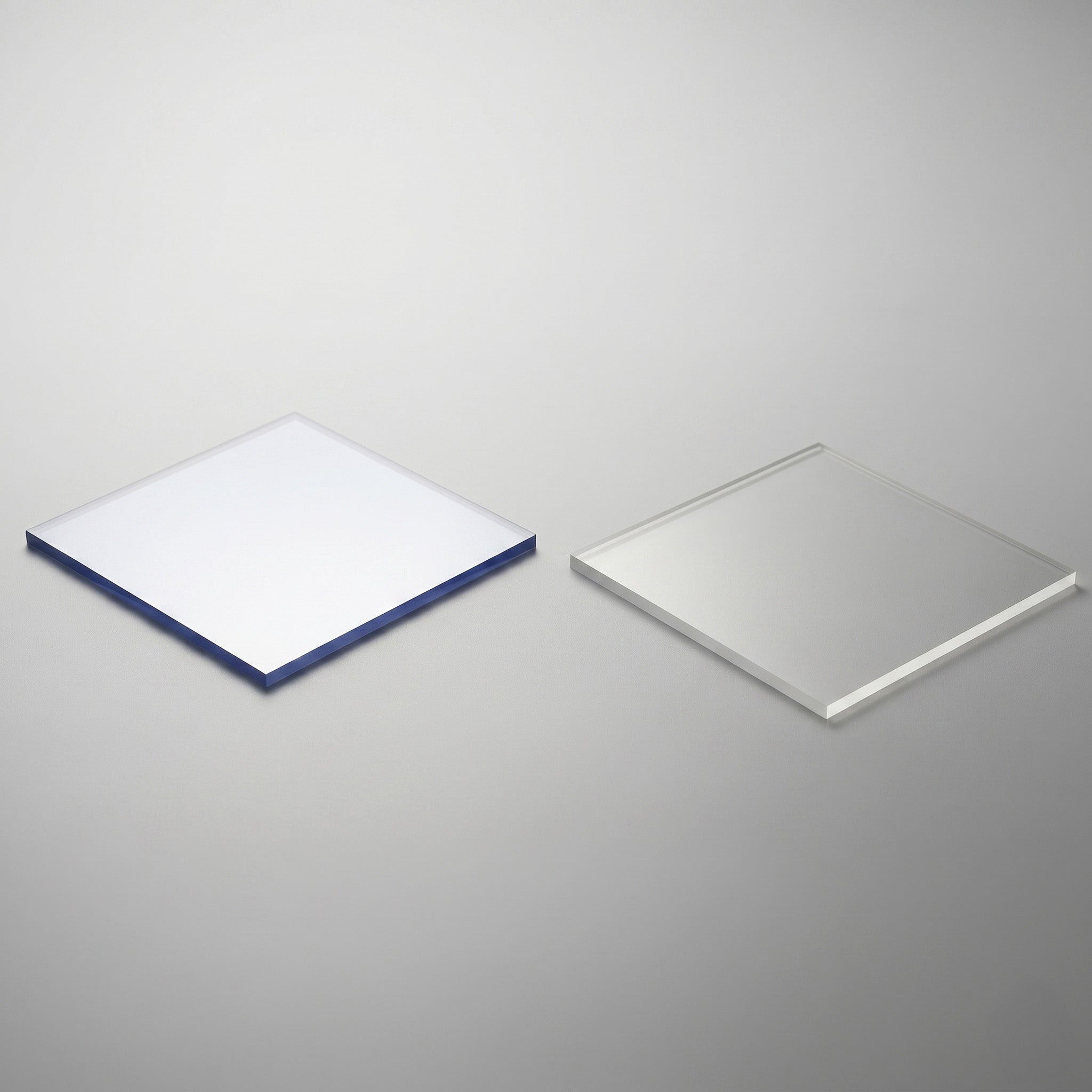
Quick Answer
Polycarbonate beats PETG on impact strength, heat resistance, and flame rating. PETG beats polycarbonate on cost and ease of fabrication. For light covers, lit signs, and LED diffusers, polycarbonate is the right choice because PETG warps near 70°C and only carries a UL94 HB flame rating. For low-heat displays, retail signage, and food-contact projects, PETG is the cheaper, easier sheet to work with.
For a real-world example, our polycarbonate emergency exit sign cage uses that impact strength to shield lighted exit signs from carts and tampering, where a PETG cover would crack.
Both polycarbonate and PETG sit in the same shelf of clear thermoplastics, and both serve as a glass substitute across various industries. Both materials are highly transparent, transmitting roughly 88 to 90 percent of visible light. Both weigh about half what glass weighs. On a spec sheet they look interchangeable. In a real fixture, sign cabinet, or machine guard, they are not.
This guide is written for the buyer who has to pick between the two for a job that involves heat, light, or impact. Lighting, signage, retail displays, machine guarding, automotive components, medical devices, and outdoor applications all push these materials in different directions. The data below is pulled from manufacturer datasheets (SABIC LEXAN, Plaskolite TUFFAK, Eastman Eastar) and ASTM test standards. No estimates.
Polycarbonate vs PETG at a glance
Here is the head-to-head comparison most lighting and sign fabricators want first.
| Property | Polycarbonate (PC) | PETG | Test Standard |
|---|---|---|---|
| Notched Izod Impact | 12.0 to 16.0 ft-lb/in | 1.7 ft-lb/in | ASTM D256 |
| Tensile Strength | 66 to 75 MPa | 53 MPa | ASTM D638 |
| Heat Deflection (HDT @ 1.82 MPa) | 125 to 135°C (257 to 275°F) | 69 to 70°C (156 to 158°F) | ASTM D648 |
| Glass Transition (Tg) | 147 to 150°C | 81°C | DSC |
| Light Transmission | 88 to 90 percent | 88 to 90 percent | ASTM D1003 |
| Density | 1.20 g/cm³ | 1.27 to 1.33 g/cm³ | ASTM D792 |
| Shore D Hardness | 90 to 95 | ~76 | ASTM D2240 |
| UL94 Flame Rating | V-0, V-2, and 5VA grades available | HB only | UL94 |
| Resin cost (virgin) | ~$2.80/kg | $1.60 to $1.80/kg | 2024 market |
Sources: Xometry materials database, MakeItFrom.com, Plaskolite TUFFAK datasheet, Eastman Eastar PETG datasheet.

What is polycarbonate?
Polycarbonate is a clear thermoplastic made from carbonate groups linked between bisphenol-A units. It is the same family of resin used in bullet-resistant glazing, motorcycle helmet visors, and most polycarbonate sheets sold for lighting, glazing, and machine guards. The two best-known polycarbonate sheet brands are SABIC LEXAN and Plaskolite TUFFAK.
For lit fixtures, the LED-diffusion grade Plaskolite TUFFAK LD has special polymer additives that scatter light and remove visible LED hotspots. There is no equivalent diffuser-grade PETG sheet on the US market. That single fact decides most professional LED light cover and channel-letter projects before any other property gets compared. Polycarbonate is a high performance material widely used for optical lenses, automotive parts, machine guards, and outdoor signage where mechanical strength and thermal stability both matter.
What is PETG?
PETG stands for polyethylene terephthalate glycol-modified. It is a polyester thermoplastic in the same family as the PET used in water bottles, with one important change: a small percentage of cyclohexanedimethanol replaces ethylene glycol in the polymer chain. That glycol modification is what stops PETG from crystallizing and gives it the optical clarity that lets it compete with acrylic and polycarbonate.
PETG sheet brands on the market include Eastman Spectar, Eastman Vivak, and Plaskolite Vivak. PETG filament for 3D printing uses the same base resin in extruded round form. The manufacturing process for PETG runs at lower extrusion temperatures than polycarbonate, which is part of why PETG is a cost effective option in lower-stress applications. For a deeper look at PETG specifically, see our PETG plastic guide.
Impact resistance: 16 ft-lb/in vs 1.7 ft-lb/in
The single biggest mechanical difference between the two materials is impact strength. Notched Izod testing under ASTM D256 gives polycarbonate a score of 12 to 16 ft-lb/in. PETG scores 1.7 ft-lb/in on the same test. Polycarbonate absorbs roughly 9 to 10 times more impact energy before it cracks.
This gap shows up in the field whenever a sheet has to survive being dropped, hit, or hit by debris. A 1/8 inch polycarbonate machine guard window stops a tool fragment that would shatter a PETG window of the same thickness. A polycarbonate skylight survives a hailstorm that turns PETG into a craze field. For ground-floor security glazing and other demanding environments, polycarbonate is the preferred choice. Its superior impact resistance is the reason it is rated impact resistant on every manufacturer datasheet.
PETG is not weak in absolute terms. It still beats acrylic for impact resistance by roughly 5 times. PETG is fine for a retail display, a sneeze guard, or an indoor pop-up sign that nothing is going to swing a hammer at. The choice depends on what the sheet has to take.
Heat resistance: why PETG fails inside an LED fixture
This is the property that disqualifies PETG from most lit fixtures. Heat deflection temperature under ASTM D648 (1.82 MPa load) measures the temperature at which a sheet starts to bend under stress. Polycarbonate holds shape up to 125 to 135°C. PETG starts to deform at 69 to 70°C.
An LED driver running inside a sealed fixture pushes case temperatures into the 60 to 80°C range. That is right at PETG's heat deflection cliff. Add ambient summer heat in a soffit, parking lot, or unconditioned warehouse and the lens warps. Polycarbonate has roughly 60°C of heat headroom over PETG, which is the difference between a lens that holds shape for 10 years and one that sags after one summer.
Glass transition temperature tells the same story. PETG hits Tg at 81°C. Polycarbonate hits Tg at 147 to 150°C. For any fixture where the lens sits within a few inches of an LED driver, an HID ballast, or a fluorescent lamp, polycarbonate is the safe specification. The dimensional stability of polycarbonate at high temperatures is what keeps lenses from sagging and channel letter faces from bowing under summer heat load.

Optical clarity and LED hotspot diffusion
Both materials transmit 88 to 90 percent of visible light in standard clear grades, giving each high clarity and clear visibility through the sheet. On clarity alone, the choice is a wash. The real difference is what each does with point-source LED light.
A clear sheet of either material puts the LED chip pattern straight through to the viewer. You see dots. To get a smooth, even glow, you need a diffuser grade. Polycarbonate has dedicated LED-diffusion grades on the market: Plaskolite TUFFAK LD, Bayer Makrolon LED, and a half-dozen smaller specialty grades. These contain light-scattering particles that hide LED hotspots without dropping output by more than 10 to 15 percent.
PETG does not have a true LED-diffusion grade in equivalent commercial supply. PETG sheets sold as "frosted" rely on surface texture, which scatters less evenly and shows directional grain. For a lit acrylic, polycarbonate, or PETG light cover or diffuser built around modern LED strips, a polycarbonate diffuser grade gives a cleaner result. This is why every major commercial troffer lens, channel letter face, and pendant globe meant for LED retrofits ships in polycarbonate, not PETG.
UV resistance and outdoor yellowing
Standard polycarbonate yellows under prolonged UV exposure unless it is co-extruded with a UV-stable cap layer. Most outdoor-rated polycarbonate sheets (Plaskolite TUFFAK XL, SABIC LEXAN MARGARD) include this UV layer and carry a 10-year warranty against yellowing and breakage.
PETG without a UV stabilizer also yellows outdoors, and it does so faster than polycarbonate. PETG sheets sold for outdoor use add UV inhibitors at the resin stage. Even with stabilizers, PETG is generally rated for shorter outdoor service than UV-protected polycarbonate. For permanent outdoor signage, lamp post globes, and street-level light covers, polycarbonate with a UV cap is the durable choice.
Inside, away from direct sun, both materials hold clarity for years. The yellowing question only matters for outdoor or high-UV indoor environments like greenhouses and skylight applications.
UL94 flame rating: V-0 vs HB
This is the second property most buyers miss until plan check rejects the spec. UL94 rates how a plastic responds to a flame. The grades from least flame-resistant to most are HB, V-2, V-1, V-0, 5VB, and 5VA. PETG is only available in UL94 HB. Polycarbonate sheet is available in HB, V-2, V-0, and 5VA grades depending on resin.
For most commercial lit fixtures over Class 2 (24V), building code calls for UL94 V-2 or better on the lens material. PETG cannot meet that requirement. Polycarbonate can. This rules PETG out of plenum-rated troffers, retail down-lighting, and anything that has to pass commercial inspection. For residential and low-voltage retail displays, the rating gap matters less.
Chemical and cleaning resistance
PETG handles acids, alkalis, and most cleaners better than polycarbonate. PETG offers excellent resistance to isopropyl alcohol, weak bleach solutions, and standard window cleaner without crazing. Polycarbonate cracks under prolonged exposure to alcohols, ammonia-based cleaners (think Windex), aromatic solvents, and aggressive industrial chemicals. For chemical stability under repeated cleaning, PETG sheets are the safer alternative material in food and pharma environments.
For medical devices, food containers, pharmaceutical packaging, and any retail display that gets wiped down with disinfectant several times a day, PETG is the safer material. For anything that just needs to be dusted or cleaned with mild soap and water, both work fine. Polycarbonate cleans with soapy water or a polycarbonate-safe cleaner. Never use ammonia, acetone, or aggressive solvents on polycarbonate.
Machinability, thermoforming, and cold-line bending
PETG is the easier material to fabricate, with easier processing on standard plastics shop equipment. It can be cut on a table saw with a fine-tooth blade, drilled with a standard plastic-grade bit, and thermoformed in a pizza oven. PETG cold-forms within tight radii without crazing. It also bonds with PETG-specific solvent cement or cyanoacrylate. The summary of material properties below covers the points that matter most when choosing between alternative materials in the same supply chain.
Polycarbonate machines and thermoforms well, but cracks easily if it is dry or stressed during cutting. Polycarbonate sheets must be dried before thermoforming. Cold-line bending of polycarbonate is possible but limits the radius. Polycarbonate bonds with two-part urethane adhesives, polycarbonate-safe acrylic cement, or mechanical fasteners. See our polycarbonate cutting guide for blades and feed rates.
Cost per square foot in sheet form
At the resin level, polycarbonate runs around $2.80/kg and PETG runs $1.60 to $1.80/kg. PETG is roughly 35 to 45 percent cheaper as raw resin. In finished sheet form, the gap narrows because polycarbonate sheet has higher production volume and more competitive supply. A 4 by 8 foot sheet of clear 1/8 inch polycarbonate typically costs 15 to 25 percent more than the same sheet in PETG.
For high-volume jobs where impact and flame ratings are not required, the PETG cost savings add up. For lighting, sign, and machine-guard work where polycarbonate is the only material that meets spec, the cost gap is rarely the deciding factor. Compared with other plastics like acrylic, both polycarbonate and PETG hold their place by offering specific advantages in high stress and high temperature environments that acrylic cannot match.

PETG polycarbonate decision matrix: which sheet for which job
This matrix compares PETG polycarbonate alternatives across application suitability for the jobs that come through KASTLITE every week. The right material for each job depends on whether the limiting factor is heat, impact, flame rating, optical clarity, ease of fabrication, or cost.
| Application | Better choice | Why |
|---|---|---|
| LED light cover or troffer lens | Polycarbonate (LD grade) | UL94 V-0 plus diffusion grade hides hotspots |
| Outdoor lamp post globe | Polycarbonate (UV cap) | Heat, UV, and impact all favor PC |
| Channel letter face (lit) | Polycarbonate | Heat and flame rating |
| Indoor retail display sign | PETG | Cheaper, clearer, easier to fabricate |
| Sneeze guard or counter shield | PETG | Easy to thermoform, chemical-cleaner safe |
| Machine guard window | Polycarbonate | Impact resistance is non-negotiable |
| Greenhouse panel | Polycarbonate (multi-wall) | Long UV life, insulation, hail resistance |
| Food container or pharma packaging | PETG | Better chemical resistance, BPA-free |
| 3D-printed prototype part | PETG (filament) | Lower extrusion temp, low warp |
| Bullet-resistant glazing | Polycarbonate | Only material that meets the spec |
Polycarbonate vs PETG vs acrylic
Many buyers landing on this comparison are weighing all three at once. Acrylic sits in the middle for impact resistance (better than glass, weaker than polycarbonate), beats both on UV resistance without a cap layer, and offers the highest natural optical clarity at 92 percent transmission. For a head-to-head on the older comparison, see our acrylic vs polycarbonate guide.
Frequently asked questions
Is PETG stronger than polycarbonate?
No. Polycarbonate has roughly 9 to 10 times the notched Izod impact strength of PETG (12 to 16 ft-lb/in vs 1.7 ft-lb/in under ASTM D256). Polycarbonate is the stronger material on every common impact and tensile test.
Is PETG cheaper than polycarbonate?
Yes. PETG resin costs about $1.60 to $1.80 per kilogram, vs $2.80 per kilogram for polycarbonate. In finished sheet form, the gap narrows to roughly 15 to 25 percent on standard sizes.
Can PETG be used outdoors?
Only with a UV stabilizer added to the resin. Standard PETG yellows outdoors faster than polycarbonate. UV-stabilized PETG is rated for shorter outdoor service than polycarbonate sheets that ship with a UV cap layer like Plaskolite TUFFAK XL.
Does polycarbonate yellow over time?
Standard polycarbonate yellows under UV exposure. Outdoor-rated polycarbonate sheets co-extruded with a UV cap layer carry 10-year warranties against yellowing and breakage.
Is PETG food-safe? Is polycarbonate food-safe?
Both are FDA-compliant for food contact in their certified grades. PETG is the more common food and pharma packaging material because of its better chemical resistance and the long-running BPA debate around polycarbonate water bottles and containers.
What temperature does PETG warp at?
PETG starts to deform at its heat deflection temperature of 69 to 70°C (156 to 158°F) under load. The glass transition temperature is 81°C. Above 70°C, PETG should not be used in load-bearing or shape-critical applications.
Can PETG be used as a light cover?
PETG works for low-heat indoor light covers below 60°C operating temperature, away from LED drivers, ballasts, or HID lamps. For LED troffers, channel letters, lamp post globes, and any commercial lit fixture, polycarbonate is the safer choice because of its higher heat tolerance and better flame rating.
Is polycarbonate or PETG flame-retardant?
Polycarbonate is available in UL94 HB, V-2, V-0, and 5VA flame ratings. PETG is only available in UL94 HB. For any fixture or fixture lens that has to meet UL94 V-2 or higher, polycarbonate is the only realistic choice.
Can you bend PETG with a heat gun?
Yes. PETG cold-forms and thermoforms easily. It can be heat-gun bent at around 80 to 90°C (175 to 195°F). Polycarbonate also thermoforms but must be dried beforehand to prevent bubbling.
Which is better for a lit sign face?
For a lit channel letter or cabinet face, polycarbonate is the better choice because of higher heat tolerance, better flame rating, and the availability of LED-diffusion grades. PETG is acceptable for unlit signs and indoor retail displays where heat and flame ratings are not at stake.
Choosing between polycarbonate and PETG
The decision usually comes down to two questions. First: does the part have to survive heat above 60°C, an open flame inspection, or repeated impact? If yes, polycarbonate. Second: does the part need to be cheap, easy to fabricate in-house, and resistant to chemical cleaners? If yes, PETG.
For lighting, signage, and outdoor work, polycarbonate is the safer specification on more than 80 percent of jobs. For retail displays, food and pharma packaging, sneeze guards, and quick-turn fabricated parts, PETG saves money without giving up much that matters.
KASTLITE stocks both polycarbonate sheets and other plastic sheets cut to size in our Clearwater, FL facility. For specific applications, see our light cover and diffuser collection or browse outdoor lamp post globes. If you have a fixture, sign, or guard project and want a second opinion on which material fits, send specs and we will recommend the right grade and gauge.