
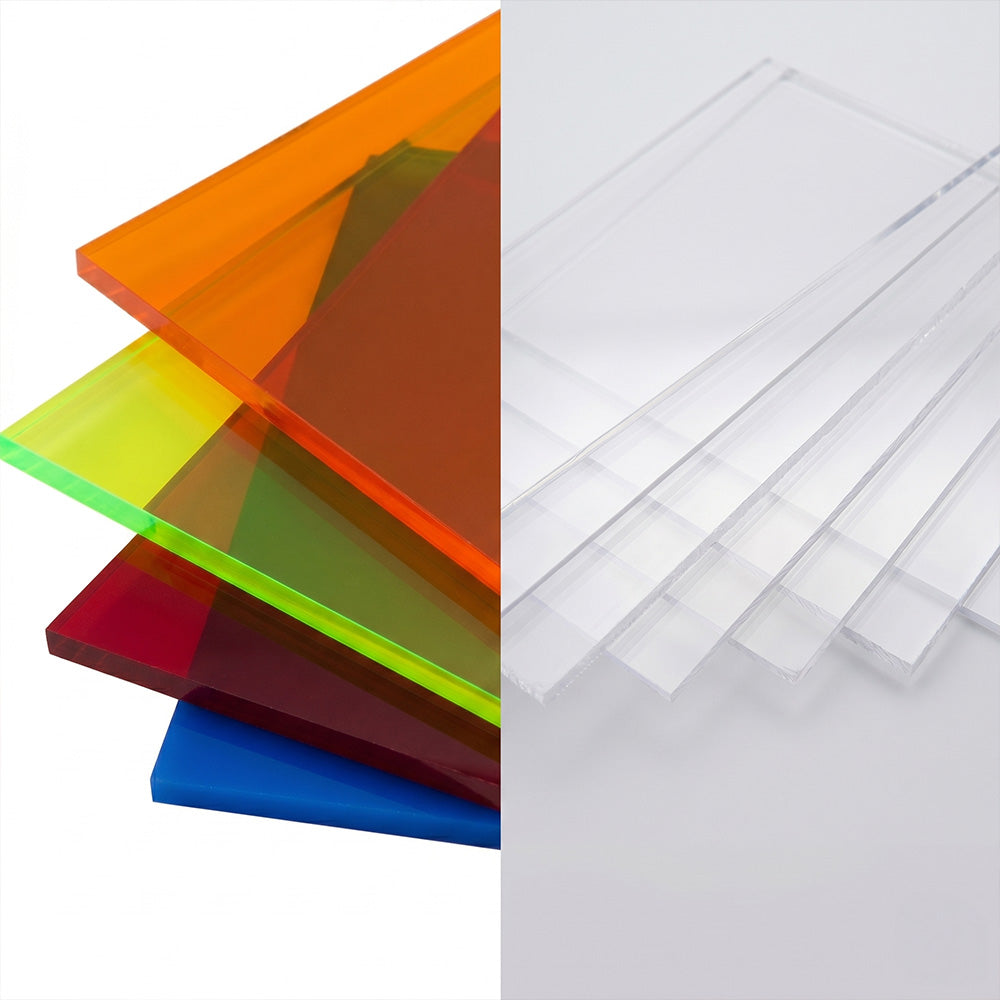
Short answer: pick acrylic (Plexiglass) when it has to look clear and stay free of scratches, as in displays, frames, signs and light panels. Pick polycarbonate (Lexan) when it could get hit, kicked or hailed on, as with machine guards, greenhouses and patio covers, because it flexes under impact where acrylic can crack. We sell both cut to size.
If you are wondering which sheet to order for a sign, a sneeze guard, a greenhouse or a machine guard, this guide compares the two on impact resistance, clarity, scratch resistance, UV, cutting, heat and cost, using manufacturer datasheet numbers, then answers the common Lexan vs Plexiglass questions. Picking wrong costs money: a panel that cracks on the first hit, or one that scuffs and yellows outdoors.
The datasheets back up the short answer. Clear cast acrylic passes 92% of visible light, and general-purpose polycarbonate passes 86% to 89%. On impact, polycarbonate scores 18 ft-lb/in in the notched Izod test against 0.4 for cast acrylic. Price may not decide it at all: on our store, 1/4 inch clear acrylic and 1/4 inch clear polycarbonate cost the same at every size we stock in both. KastLite is based in Clearwater, Florida, and ships acrylic sheets and polycarbonate sheets free to the lower 48 states on orders over $40.

What Is Acrylic?
Acrylic is the common name for polymethyl methacrylate (PMMA), the clear plastic sold as Plexiglass, ACRYLITE, Lucite and Perspex. The German company Röhm & Haas first brought it to market in 1933. Röhm still owns the two main trademarks for the sheet: PLEXIGLAS in Europe, Asia, Africa and Australia, and ACRYLITE in the Americas.
Clear cast acrylic transmits 92% of visible light, according to the ACRYLITE cast datasheet. Its surface is hard for a plastic (Rockwell M-94), so it resists scuffs better than polycarbonate. It also weighs about half as much as glass: Plaskolite lists 1/8 inch acrylic at 0.75 lb per square foot against 1.60 lb for glass. And it holds up in sunlight with no coating at all. Smooth, colorless ACRYLITE sheet is warranted for ten years against a change in light transmission of more than 3%.
The ACRYLITE datasheet describes cast acrylic as a lightweight, rigid thermoplastic with many times the breakage resistance of standard glass. The drawback is that it is still brittle next to polycarbonate. Acrylic saws, drills and routs much like wood or brass with small changes to the tools, but a sharp blow can crack it. In Plaskolite's drop-ball test, acrylic broke at 1.75 ft-lbs of impact energy.
Common uses for acrylic include retail displays and display cases, picture frames, aquarium panels, sneeze guards, signs and light diffusers. For these projects, start with our 1/8 inch clear acrylic plexiglass sheet or the stiffer 1/4 inch clear acrylic sheet.
What Is Polycarbonate?
Polycarbonate (PC) is a thermoplastic known first for impact strength. Lexan is SABIC's brand of polycarbonate sheet; Makrolon, TUFFAK and PALSUN are others. Hermann Schnell at Bayer patented the first linear polycarbonate in 1953, and Daniel Fox at General Electric made one independently the same year.
Clear polycarbonate is also transparent but passes a little less light than acrylic: 86% for Plaskolite's TUFFAK GP at 0.118 inch (3 mm) and 89% for Palram's PALSUN. It weighs about the same (specific gravity 1.2 against 1.19 for acrylic) and handles more heat. Plaskolite rates TUFFAK for continuous service up to 212°F (100°C), while the ACRYLITE datasheet sets 180°F (82°C) as the ceiling for cast acrylic. That margin matters near light fixtures, machinery and enclosures that bake in direct sun.
Impact strength is where the two materials split. TUFFAK GP polycarbonate scores 18 ft-lb/in in the notched Izod test, about 45 times the 0.4 the ACRYLITE datasheet lists for cast acrylic. In Plaskolite's 0.5 lb drop-ball comparison, polycarbonate did not break at all, acrylic broke at 1.75 ft-lbs and glass at 0.7 ft-lbs. Sheet makers put the gap with glass more bluntly: SABIC says its LEXAN EXELL-D sheet is 250 times more impact resistant than glass. That high impact resistance makes PC the more durable sheet anywhere it can be hit.
Its weak spot is the surface. PC is softer (Rockwell M70 against M-94 for acrylic), so it scuffs more easily, and acrylic is generally the more scratch resistant of the two. It also needs UV protection outdoors. Plaskolite notes that TUFFAK GP has limited weathering properties, and Palram ships its PALSUN polycarbonate sheet with the UV-protected side clearly marked so you can face it toward the sun.
Common uses include machine guards, safety glazing, greenhouse panels, windshields and protective barriers. We stock 1/8 inch clear polycarbonate sheet and 1/4 inch clear polycarbonate sheet in preset sizes, plus custom clear polycarbonate sheet in 1/16 to 1/2 inch thicknesses. Browse the full polycarbonate sheet collection to compare every thickness.
Lexan vs Plexiglass: Brand Names for the Same Comparison
Lexan vs Plexiglass is the polycarbonate vs acrylic question asked with brand names. Lexan is SABIC's trade name for polycarbonate sheet. Plexiglas, with one s, is Röhm's trademark for acrylic, and plexiglass, with two s's, is the everyday spelling that we also use in our own product names for clear acrylic sheet. So when a contractor says Lexan and a hardware store says Plexiglass, they mean the two materials compared on this page.
Which is stronger, Lexan or Plexiglass? Lexan, by a wide margin on impact: 18 ft-lb/in against 0.4 on the notched Izod figures above. Which is clearer and harder to scratch? Plexiglass, with 92% light transmission and a Rockwell hardness of M-94.
One honest note on our own stock: our polycarbonate is not SABIC Lexan. It is clear, UV-stabilized general-purpose polycarbonate, the same polymer that Lexan, TUFFAK and Makrolon sheets are made from. Our acrylic is clear acrylic sheet, sold under the everyday name plexiglass.
How Each Sheet Is Made: The Manufacturing Process
Acrylic sheet comes two ways. Cell casting, where polymerization and molding happen at the same time, produces the highest-quality PMMA sheet; ACRYLITE cast is made this way. Extruded acrylic, such as ACRYLITE FF, is formed as a continuous sheet. The process matters in the shop: cast sheet forms at a higher temperature than extruded sheet (see Bending and Forming below).
Polycarbonate sheet is typically extruded: melted resin is pushed through a die and rolled between cylinders into sheet from about 0.5 to 20 mm thick. Plaskolite's TUFFAK, for example, is extruded solid polycarbonate sheet, offered in clear, gray and bronze tints and in matte, prismatic and pebble textures.
Acrylic vs Polycarbonate: Side-by-Side Comparison
This table compares the physical characteristics of standard clear sheet for quick reference. Lab values come from the ACRYLITE cast datasheet and Plaskolite's TUFFAK GP datasheet, so both materials were measured with the same ASTM test methods. Cost comes from our own store on November 5, 2026.
| Property | Acrylic (Plexiglass) | Polycarbonate (Lexan) |
|---|---|---|
| Impact resistance | 0.4 ft-lb/in notched Izod (ASTM D256); broke at 1.75 ft-lbs in a 0.5 lb drop-ball test | 18 ft-lb/in notched Izod (ASTM D256); did not break in the same drop-ball test |
| Clarity (light transmission, ASTM D1003) | 92% | 86% (TUFFAK GP, 3 mm) to 89% (PALSUN) |
| Scratch resistance (Rockwell hardness, ASTM D785) | Harder surface: M-94 | Softer surface: M70, scuffs more easily |
| UV resistance and outdoor use | Weathers well with no coating; ACRYLITE is warranted 10 years against more than a 3% loss of light transmission | Needs a UV-protected surface facing the sun; general-purpose sheet has limited weathering properties |
| Cutting and drilling | Saws, drills and routs like wood or brass with small tool changes; laser cuts leave a polished edge | Standard drill bits work, plastic bits drill cleanest; laser cutting can discolor the edge |
| Heat limit (continuous service) | 180°F (82°C), cast sheet | 212°F (100°C) |
| Cost tier (KastLite, Nov 5, 2026) | Same price as polycarbonate at 1/4 inch; lower at most 1/8 inch sizes | Same price as acrylic at 1/4 inch; 4% to 46% more at 1/8 inch, 24 x 24 inches and up |
| Best uses | Displays, frames, signs, aquariums, light diffusers, indoor glazing | Machine guards, safety glazing, greenhouses, patio covers, spots that get kicked or hit |
Sources: ACRYLITE cast physical properties; TUFFAK GP polycarbonate data sheet (Plaskolite), which also holds the drop-ball comparison; TUFFAK fabrication guide (Plaskolite); ACRYLITE UV transmission note.

When to Choose Acrylic
Acrylic is the right call whenever clarity and aesthetics matter more than impact strength. These are the jobs where its benefits beat polycarbonate.
Retail Displays and Point-of-Purchase Stands
With 92% light transmission and a harder surface, acrylic keeps merchandise behind it looking crisp. If the panel sits inside a store where nobody is going to hit it with a baseball bat, acrylic wins.
Picture Frames and Museum Cases
UV-filtering acrylic such as ACRYLITE Gallery OP-3 absorbs about 98% of incident UV light, which is why framers use it for photos and prints. ACRYLITE OP-2 cell cast sheet filters at the same level and is used in museums to protect old documents and artifacts.
Signage and Lettering
A CO2 laser vaporizes acrylic as it cuts and leaves a clean, polished edge; the ACRYLITE datasheet recommends annealing laser-cut parts to lower the stress in that edge. For color work, see our colored acrylic sheets and colored acrylic sheet packs.
Aquariums and Fish Tanks
Acrylic panels bond with solvent or polymerizable cements, such as ACRIFIX, so seams can be joined without a frame. That, plus 92% light transmission, is why acrylic suits aquarium panels.
Skylights and Roof Panels (Low-Traffic Areas)
For skylights out of reach of hail and foot traffic, acrylic gives you better clarity and better UV performance with no coating to install the right way up.
Light Diffusers and Lens Covers
Acrylic is a standard material for fluorescent light covers, LED panel diffusers and decorative fixtures because it is clear, light and easy to thermoform. We carry a wide range of plastic light covers and diffuser panels. For covers that need more impact strength than acrylic, compare polycarbonate vs PETG.
When to Choose Polycarbonate
Polycarbonate is the right material when the panel might take a hit, run hot, or sit where breakage would hurt someone. These are the projects where it clearly wins.
Safety Glazing and Protective Barriers
Machine guards, shields and security windows need a sheet that absorbs a hit without shattering. An 18 ft-lb/in notched Izod rating, about 45 times that of cast acrylic, makes polycarbonate our top choice wherever a struck or thrown part is the main hazard.
Greenhouses and Agricultural Enclosures
Hail that can crack acrylic is far less likely to break polycarbonate, which came through Plaskolite's drop-ball test without breaking. Twin-wall polycarbonate panels add an air gap between the two skins, and that gap helps hold heat in.
Bullet-Resistant and Security Glazing
Ballistic glazing is built from thick, tested polycarbonate laminates. Plaskolite, for example, lists laminates rated to UL 752 Level 1 and higher. The rating belongs to those tested laminates. A single clear polycarbonate sheet, including ours, is not a bullet-resistant product.
Outdoor Enclosures in Extreme Climates
Polycarbonate stays tough in deep cold (Plaskolite lists a brittleness temperature of -200°F for TUFFAK GP) and runs continuously up to 212°F, against 180°F for cast acrylic. Near heat sources or in strong sun, that 32 degree margin favors polycarbonate.
High-Traffic Areas and Vandal-Prone Installations
Bus shelters, transit stops and outdoor kiosks take kicks and punches. A blow that can crack acrylic is unlikely to break polycarbonate, which flexes under load and returns to shape.
Roofing and Canopy Panels in Hail Zones
If you get hail, use polycarbonate for patio covers, carports and walkway canopies. It flexes under a strike where acrylic is more likely to crack. Pick a UV-protected grade for any roof that sees full sun.
Cost Comparison
Here is what the two materials cost on our store, checked on November 5, 2026.
Price Ranges by Thickness
At 1/4 inch, clear acrylic and clear polycarbonate are the same price at all 14 sizes we stock in both. At 1/8 inch, polycarbonate costs more at 12 of those 14 sizes, and 4% to 46% more at 24 x 24 inches and larger. A few examples:
- 1/4 inch, 12 x 24 inches: acrylic $30.99, polycarbonate $30.99
- 1/4 inch, 24 x 48 inches: acrylic $69.99, polycarbonate $69.99
- 1/8 inch, 24 x 24 inches: acrylic $34.99, polycarbonate $50.99
- 1/8 inch, 36 x 48 inches: acrylic $102.99, polycarbonate $115.99
Prices change, so check the product page for today's figure. Other sellers price the two differently, so compare like for like: same thickness, same size, same grade.
Total Cost of Ownership
The upfront price does not tell the whole story. If an acrylic panel cracks after two years in a high-impact spot and has to be replaced, polycarbonate would have been cheaper in the long run. Weigh the setting, the expected lifespan and how hard the panel is to replace.
For indoor work with little impact risk (displays, frames, signs), acrylic's equal or lower price and better clarity make it the obvious value pick. For outdoor or high-impact work, polycarbonate's toughness usually pays for itself by avoiding replacements.
Fabrication and Working Tips
Both materials can be cut, drilled, bent and bonded, but each behaves differently in the shop. Knowing the differences before you start saves time and ruined sheets.
Cutting
Acrylic cuts cleanly on table saws, band saws and laser cutters. Keep the protective film on while you cut to avoid scratches. A laser leaves a polished edge on acrylic.
Polycarbonate cuts well with standard saws. On a laser, Plaskolite warns that it can discolor slightly at the cut edge, so a saw or router gives a cleaner result. For blades, tools and step-by-step methods, see our guide on how to cut polycarbonate sheets.
Drilling
Acrylic drills much like brass with slightly modified bits, per the ACRYLITE datasheet. Back the sheet with scrap wood and keep the speed moderate so the bit does not grab.
Polycarbonate is more forgiving. Plaskolite says standard drills and bits work on TUFFAK sheet, with plastic-specific bits giving the cleanest holes and drill-point angles of 60 to 90 degrees. Smaller angles suit smaller holes.
Bending and Forming
Acrylic must be heated before bending: cast sheet to roughly 340-380°F (171-193°C) and extruded sheet to 290-320°F (145-160°C), the ranges in U.S. Plastic's acrylic forming guide. In that range it turns pliable and can be shaped over jigs or molds, and it keeps the new shape once it cools. Strip heaters (line benders) are the standard tool for clean bends in acrylic sheet.
Polycarbonate can be cold-bent much tighter than acrylic without cracking. Plaskolite puts the minimum cold-bend radius at 100 times the sheet thickness, so a 1/8 inch sheet can bend to a 12.5 inch radius; its own comparison lists 180 times for acrylic, and ACRYLITE lists 330 times for its cast sheet. For sharper bends or vacuum forming, heat polycarbonate to roughly 350-360°F (177-182°C), the range U.S. Plastic lists for TUFFAK GP sheet. Plaskolite lists curved glazing among the uses for its cold-formable TUFFAK grades.
Bonding and Gluing
Acrylic bonds well with solvent or polymerizable cements, such as ACRIFIX, which is why it works so well for display cases and aquarium seams.
Polycarbonate can also be glued and solvent bonded, according to Plaskolite. For structural assemblies, use mechanical fasteners in oversized holes so the sheet can expand and contract with temperature.
Environmental and Safety Considerations
Both are thermoplastics. Ask your local recycling program before you put either sheet in a curbside bin.
On fire, check the rating for your exact grade and thickness. The ACRYLITE datasheet reports a burning rate of 1.2 inches per minute for 3 mm ACRYLITE cast acrylic (ASTM D635), so acrylic keeps burning once lit. Plaskolite rates TUFFAK GP polycarbonate UL 94 HB at 0.060 inch and UL 94 V-0 at 0.394 inch. If a fire code applies to your project, confirm the listing for the sheet you plan to buy.
Chemical resistance differs too. The ACRYLITE datasheet says cast acrylic resists many chemicals, including dilute acids such as sulfuric acid up to 30%, ammonia solutions and hexane, but aromatic solvents such as benzene and toluene attack it. Plaskolite describes TUFFAK as having good chemical resistance to a wide range of substances. Check the maker's chemical chart before either sheet goes near solvents.
Polycarbonate also keeps its toughness in the cold and tolerates more heat than acrylic, which helps outdoors where temperatures swing from night to midday sun.
Frequently Asked Questions
Is Plexiglass the same as acrylic?
Yes. Plexiglass is the common name for clear acrylic sheet (PMMA). PLEXIGLAS, with one s, and ACRYLITE are both Röhm trademarks for the same sheet; ACRYLITE is the name used in the Americas. Lucite and Perspex are other names for the same polymer. Polycarbonate, sold as Lexan, is a different plastic.
Which is stronger, Lexan or Plexiglass?
Lexan (polycarbonate) is far stronger on impact. Manufacturer datasheets list a notched Izod impact strength of 18 ft-lb/in for general-purpose polycarbonate sheet and 0.4 ft-lb/in for cast acrylic. Plexiglass (acrylic) wins on clarity, 92% light transmission against 86% to 89%, and on surface hardness.
Which is cheaper, acrylic or polycarbonate?
It depends on the thickness and the seller. On our store on November 5, 2026, 1/4 inch clear acrylic and clear polycarbonate cost the same at all 14 sizes we stock in both. At 1/8 inch, polycarbonate cost more at 12 of the 14 sizes. Check the product pages for current prices.
Is acrylic or polycarbonate better for outdoor use?
It depends on the risk of impact. Acrylic weathers well without a coating, and colorless ACRYLITE is warranted for ten years against more than a 3% loss of light transmission. Unprotected polycarbonate weathers in the sun, and yellowing is the first sign, so outdoor sheet needs a UV-protected face installed toward the sun, but it survives hail, branches and vandalism far better. Our clear polycarbonate is UV stabilized. For a patio cover in hail country, choose polycarbonate. For a sign in a sheltered spot, choose acrylic.
Can I use acrylic or polycarbonate instead of glass windows?
Yes. Acrylic passes 92% of visible light and weighs about half as much as glass, which suits storm windows, secondary glazing and shed windows. For windows that could be hit, such as basements, garages and workshops, choose polycarbonate for its impact strength.
Which is better for a light diffuser or light cover?
For most indoor fixtures, acrylic: it passes more light and resists scratches better. Choose polycarbonate for covers in gyms, parking garages and other places where a ball or a tool could hit the fixture, or where the cover runs hot. Learn what a light diffuser does or shop our light covers and diffusers.
For a side-by-side of the main plastic sheet types with ASTM test data, see our plastic sheet material properties guide.
Need help choosing the right thickness? Our plastic sheet thickness guide maps recommended sizes by application.
Working with polycarbonate? Our polycarbonate cutting guide covers tools, blades and step-by-step methods.
Considering a third option? Our PETG guide explains how it compares to both acrylic and polycarbonate.
Where to Buy Acrylic and Polycarbonate Sheets
Order acrylic or polycarbonate cut to size for home and commercial projects. KastLite is based in Clearwater, Florida, ships free to the lower 48 states on orders over $40, and ships to Canada on orders of $100 or more. Our plastic sheet collection carries acrylic, polycarbonate and other plastic sheet.
Not sure which material fits your next project? Call us at 800-587-3310 or send us a message. You can also read our beginner's guide to ABS plastic sheets if you are weighing options beyond acrylic and polycarbonate.