
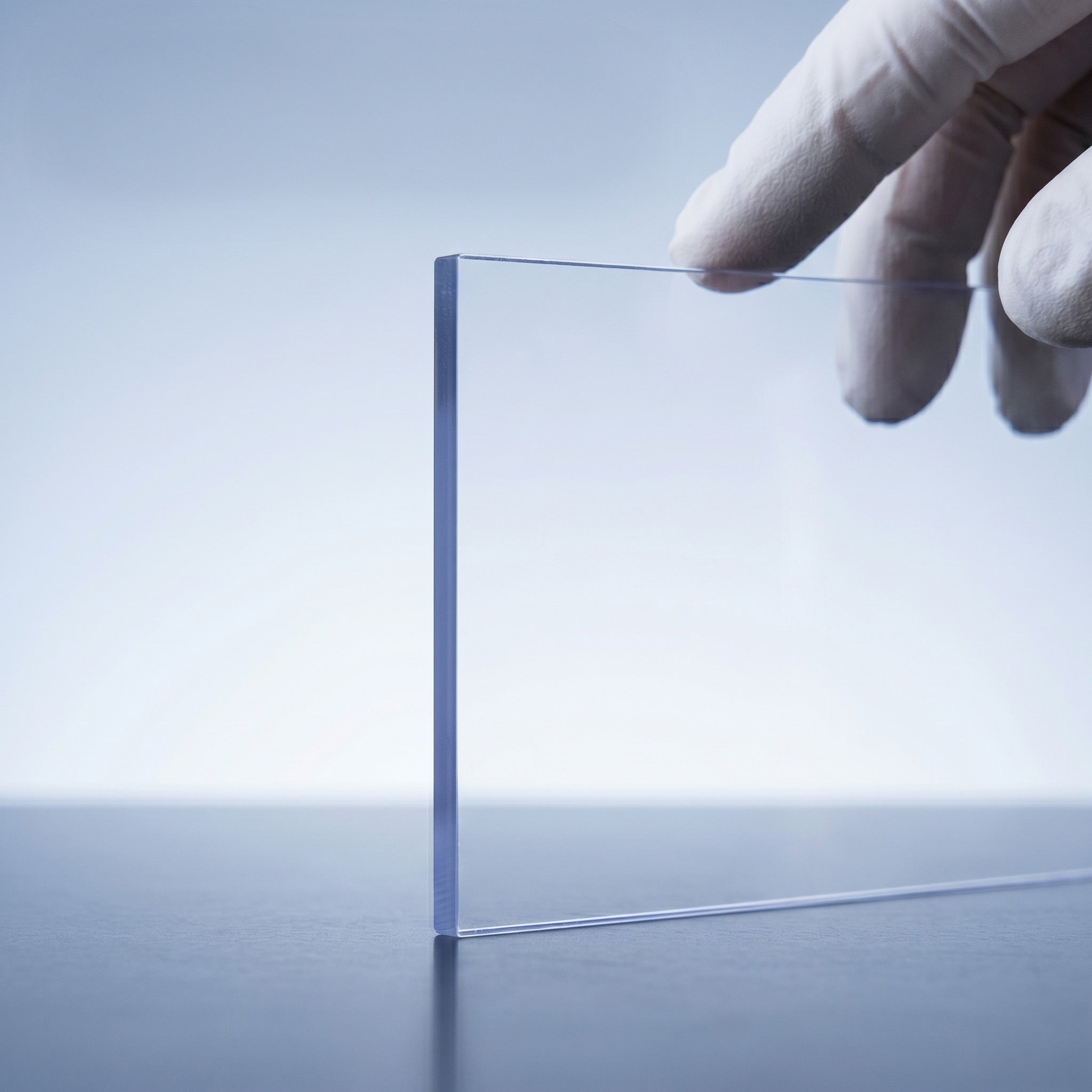
PETG (polyethylene terephthalate glycol-modified) is a clear, tough thermoplastic polyester that sits between acrylic and polycarbonate in both price and performance. It absorbs impact without cracking, thermoforms at low temperatures, and meets FDA requirements for direct food contact. If acrylic is too brittle for your project and polycarbonate is overkill, PETG is probably the right sheet.

What Is PETG Plastic?
PETG starts as PET, the same polyester used in water bottles and food packaging. During manufacturing, glycol (specifically cyclohexanedimethanol) replaces some of the ethylene glycol in the polymer chain. This modification prevents the plastic from crystallizing as it cools, giving PETG an amorphous structure that stays clear, flexible, and impact-resistant instead of turning cloudy and brittle like standard PET.
The result is a thermoplastic polyester sheet that combines the chemical resistance and clarity of PET with better toughness and easier fabrication. PETG is available as solid flat sheet (the type KASTLITE sells), extruded film for packaging, and filament for 3D printing. This guide focuses on PETG sheet for lighting, signage, display, and fabrication projects.
PETG Material Properties (ASTM Test Data)
The table below lists typical properties for standard-grade PETG sheet at 1/8 inch (3 mm) thickness.
| Property | Typical Value | Test Method |
|---|---|---|
| Tensile Strength | 7,500 psi | ASTM D638 |
| Izod Impact Strength (Notched) | No break / 1.5 ft-lb/in | ASTM D256 |
| Light Transmission | 88-90% | ASTM D1003 |
| Heat Deflection Temperature | 158°F (70°C) | ASTM D648 |
| Glass Transition Temperature | 176°F (80°C) | DSC |
| Rockwell Hardness | R-106 | ASTM D785 |
| Density | 1.27 g/cm³ | ASTM D792 |
| Water Absorption (24h) | 0.2% | ASTM D570 |
| Flammability | HB | UL 94 |
| FDA Food Contact | Yes (standard grade) | 21 CFR |
For a side-by-side comparison with acrylic, polycarbonate, PVC, and ABS, see our material properties comparison guide.
Advantages of PETG Sheets
- Impact resistance without brittleness. Most PETG sheets score "no break" on the Izod notched impact test per ASTM D256. Where acrylic shatters under a sharp blow, PETG flexes and absorbs the energy. It handles about 70% of the impact force polycarbonate can take, at a lower cost
- Easy thermoforming. PETG has the lowest forming temperature of any common clear plastic sheet. It bends and shapes at 250-320°F without pre-drying, making it the preferred material for vacuum forming, blister packaging, and curved retail displays
- FDA food contact compliance. Standard-grade PETG meets FDA 21 CFR requirements for direct contact with food. That makes it legal for sneeze guards, food display bins, bakery cases, and cafeteria tray covers without any special coating or treatment
- Good chemical resistance. PETG resists diluted acids, alkalis, and most common cleaning chemicals. You can wipe it down with household cleaners and commercial sanitizers without clouding or cracking
- Clear with good light transmission. At 88-90% per ASTM D1003, PETG transmits nearly as much light as acrylic (92%). For most display and lighting applications, the 2-4% difference is not noticeable
- Does not yellow as fast as polycarbonate. Standard PETG holds its clarity longer than uncoated polycarbonate under indoor lighting conditions. For outdoor use, neither PETG nor polycarbonate is UV-stable without additives
- Very low shrinkage. PETG maintains dimensional stability during thermoforming, so parts hold their shape and tolerances after cooling
Disadvantages of PETG Sheets
PETG is not the right material for every job. Here are the trade-offs:
- Lower scratch resistance than acrylic. PETG is softer on the Rockwell scale (R-106 vs. M-95 for acrylic). It picks up surface scratches more easily, and those scratches are harder to polish out. For applications where optical perfection matters (display cases, picture framing), acrylic is the better choice
- Low heat tolerance. PETG softens at just 158°F (70°C) per ASTM D648. Do not use it near heat-producing fixtures, in direct sunlight behind glass, or in applications where ambient temperatures exceed 140°F. Polycarbonate (270°F) or acrylic (180°F) handle heat better
- Not UV-stable for outdoor use. Standard PETG will yellow and become brittle after 3-5 years of direct sun exposure. For outdoor projects, choose acrylic (naturally UV-stable) or UV-coated polycarbonate
- Lower tensile strength than acrylic. At 7,500 psi vs. 10,500 psi, PETG is not as rigid. Over large unsupported spans, PETG sheet may bow more than acrylic at the same thickness
- Not as impact-resistant as polycarbonate. PETG handles about 70% of polycarbonate's impact energy. For safety-critical applications like machine guards or security glazing, polycarbonate is still the better option
What Is PETG Used For? (Sheet Applications)
PETG sheet is used across food service, retail, medical, and industrial applications. Here are the most common uses relevant to KASTLITE customers:
Food Service and Display
Sneeze guards, salad bar covers, bakery case panels, bulk food bin liners, cafeteria tray covers. PETG's FDA compliance makes it the go-to material for any transparent barrier or display that contacts food. It is tougher than acrylic in high-traffic food service environments where panels get bumped, pushed, and cleaned multiple times a day.
Retail Signage and Point-of-Purchase Displays
Shelf talkers, countertop displays, hanging signs, price tag holders, product dispensers. PETG accepts screen printing and digital printing well, holds its shape after thermoforming, and survives the daily wear of a retail environment better than acrylic.
Light Covers and Diffuser Panels
PETG works as a light cover material where impact resistance matters more than optical perfection. In schools, gyms, and warehouses where ceiling panels get hit by balls, equipment, or debris, a PETG diffuser panel survives impacts that would shatter an acrylic panel. The 88-90% light transmission is close enough to acrylic's 92% that most people cannot tell the difference on an installed fixture.
Browse our light covers and diffusers collection for acrylic and PETG options.
Machine Guards and Protective Barriers
For light-duty to medium-duty machine guards where full polycarbonate is not required, PETG provides a cost-effective alternative. It also resists many chemicals that attack polycarbonate, making it a better choice for guards near cleaning stations, food processing lines, or chemical handling areas.
Medical and Pharmaceutical
Medical device packaging, sterilization trays, face shields, and prosthetic components. PETG withstands gamma radiation and ethylene oxide sterilization without degrading, and its FDA-compliant grades meet the requirements for medical device packaging.

The Difference Between PET and PETG
PET (polyethylene terephthalate) and PETG (polyethylene terephthalate glycol-modified) start from the same base monomers but behave differently because of the glycol modification.
| Property | PET | PETG |
|---|---|---|
| Structure | Semi-crystalline | Amorphous (stays clear) |
| Clarity | Can turn hazy when cooled | Stays optically clear |
| Impact resistance | Moderate | High (no-break on Izod) |
| Thermoforming | Requires pre-drying | No pre-drying needed |
| Common form | Bottles, film, fiber | Sheets, displays, packaging |
| Recyclable | Yes (#1 plastic) | Yes (same resin code) |
The practical takeaway: PET is for bottles and thin film. PETG is for rigid sheets, formed parts, and fabricated panels. When someone says "PETG sheet," they mean the glycol-modified version.

PETG vs. Acrylic: When to Choose Each
Acrylic and PETG are the two most common clear plastic sheets for displays, signage, and light covers. Acrylic also comes in colored and opaque finishes. Here is when to choose each:
- Choose acrylic when optical clarity is the top priority (92% vs. 88% light transmission), when scratch resistance matters (display cases, picture frames), when UV stability is needed for outdoor use, or when you need the sheet to stay rigid over a large span
- Choose PETG when the panel will get hit or bumped (food service, retail, schools), when you need FDA food contact compliance, when you plan to thermoform the sheet into a curved shape, or when chemical resistance to cleaners and sanitizers is important
For a deeper comparison of all five plastic sheet materials, see our acrylic vs. polycarbonate guide and our material properties comparison.
PETG vs. Polycarbonate: When to Choose Each
- Choose polycarbonate when maximum impact resistance is required (machine guards, security glazing, skylights), when heat tolerance above 200°F is needed, or when the panel must meet UL 94 V-2 flammability requirements
- Choose PETG when you need FDA food compliance, when the project involves thermoforming, when chemical resistance to cleaners matters more than extreme impact strength, or when you want to save 20-30% on material cost compared to polycarbonate
PETG handles about 70% of the impact energy polycarbonate absorbs. For many commercial applications, that is more than enough. The cost savings and easier fabrication often tip the decision toward PETG unless the application specifically demands polycarbonate-level strength.
How to Work with PETG Sheets
PETG fabricates easily with standard shop tools:
- Cutting: Use a circular saw or table saw with a fine-toothed carbide blade (60-80 teeth). PETG cuts cleanly without the melting tendency of polycarbonate. See our cutting guide for blade specs (same blades work for PETG)
- Thermoforming: Heat to 250-320°F in an oven or with a strip heater. PETG does not require pre-drying (unlike PET), which saves time in production. It pulls vacuum-formed parts with sharp detail and low spring-back
- Bending: A strip heater set to 300°F produces clean bends. PETG bends to tighter radii than acrylic without cracking
- Bonding: Solvent-cement with cyclohexanone or methylene chloride. Cyanoacrylate (super glue) and epoxy also work for structural joints
- Printing: PETG accepts screen printing, UV printing, and digital printing. Its slightly textured surface holds ink better than polycarbonate
For thickness selection by application, see our thickness guide.
Shop Cut-to-Size Plastic Sheets at KASTLITE
KASTLITE cuts acrylic, polycarbonate, and PETG to your exact size in-house in Clearwater, Florida. The Amazon store holds a 4.6 out of 5 rating across more than 2,200 reviews.
- Browse all plastic sheets by material and thickness.
- 1/4 inch Thick Polycarbonate Sheet ships ready to use.
Frequently Asked Questions
Is PETG food safe?
Yes. Standard-grade PETG meets FDA 21 CFR requirements for direct food contact. It is BPA-free and safe for sneeze guards, food display cases, and packaging that touches food.
Can PETG be used outdoors?
Not for extended periods without UV stabilizers. Standard PETG yellows and becomes brittle after 3-5 years in direct sunlight. For outdoor use, choose acrylic (naturally UV-stable) or UV-coated polycarbonate.
Is PETG stronger than acrylic?
In impact resistance, yes. PETG absorbs significantly more impact energy than acrylic before breaking. In tensile strength and rigidity, no. Acrylic is stiffer (10,500 psi vs. 7,500 psi) and resists bowing better over long spans.
What temperature can PETG handle?
PETG softens at 158°F (70°C) per ASTM D648. Its glass transition temperature is around 176°F (80°C). Do not use PETG in applications where temperatures exceed 140°F. For higher heat, use polycarbonate (up to 270°F) or acrylic (up to 180°F).
Does PETG yellow over time?
Indoors, PETG holds its clarity well under fluorescent and LED lighting. Outdoors, standard PETG yellows after 3-5 years of UV exposure. It yellows slower than uncoated polycarbonate but faster than acrylic, which does not yellow at all.
Can I recycle PETG?
Yes. PETG uses the same #1 resin identification code as PET and is accepted by most recycling programs that handle PET bottles and containers.
Shop PETG Sheets at KASTLITE
KASTLITE stocks PETG sheets in standard thicknesses for display, food service, lighting, and fabrication projects. Whether you need a single panel or bulk sheets cut to size, we ship across the United States.
Browse our plastic sheets collection or contact our team for custom sizing and project recommendations.
All values represent typical properties for standard-grade commercial PETG sheet. Actual values may vary by manufacturer and thickness. For project-critical specifications, request a material data sheet from our team.