
Commercial lighting accounts for roughly 17% of all electricity consumed in U.S. commercial buildings, according to the U.S. Energy Information Administration. For small businesses operating on tight margins, that percentage translates directly into money leaving the building every month. The good news: affordable automation upgrades can cut lighting energy costs by 30-60% with payback periods as short as 12-18 months.
The SBA business finance guide covers how operational upgrades like lighting retrofits can lower overhead and improve margins.
Small businesses can qualify for rebates through the ENERGY STAR commercial lighting program, which certifies fixtures that meet strict efficiency standards.
This guide covers specific upgrade paths, real cost numbers, ROI calculations, and the KASTLITE products that make each upgrade practical for small businesses.
Why Commercial Lighting Upgrades Pay for Themselves
The math on lighting upgrades is some of the simplest ROI math in business. Here is a concrete example:
A 2,000 square foot retail store running 40 fluorescent T8 fixtures at 32 watts each for 12 hours per day uses about 5,606 kWh per year on lighting alone. At the national average commercial electricity rate of roughly 14 cents per kWh (EIA, 2025), that costs about $785 per year.
Replacing those 40 fluorescent tubes with LED equivalents at 18 watts each drops consumption to 3,154 kWh, saving $343 per year. The LED tubes last 50,000+ hours compared to 20,000 hours for fluorescent, cutting replacement costs in half. Total first-year savings (energy + maintenance): roughly $450-500.
LED retrofit tubes cost $8-15 each, so the full upgrade runs $320-600. Payback period: 8-14 months. That is before factoring in utility rebates, which cover $2-8 per tube in many areas.
Upgrade Path 1: LED Retrofit (Fastest Payback)
LED retrofitting means replacing fluorescent tubes or bulbs with LED equivalents that fit existing fixtures. No new fixtures, no rewiring, and no electrician needed in most cases.
What You Need
- Type A (Plug-and-Play) LED tubes: Work with existing fluorescent ballasts. Swap the tube, done. Best for facilities that want minimal disruption
- Type B (Ballast Bypass) LED tubes: Wire directly to line voltage, bypassing the ballast. Slightly more installation work, but eliminates ballast failures and saves an additional 3-5 watts per tube
Energy Savings
A standard 4-foot T8 fluorescent tube draws 32 watts. An equivalent LED T8 tube draws 15-18 watts while producing the same lumens (around 1,800-2,200 lm). That is a 44-53% reduction in wattage per tube. The U.S. Department of Energy notes that a 12-watt LED produces equivalent light output to a 15-watt fluorescent.
Cost Breakdown
| Item | Cost Range |
|---|---|
| Type A LED tube (4-foot) | $8-12 per tube |
| Type B LED tube (4-foot) | $6-10 per tube |
| Electrician (Type B install, per fixture) | $15-25 |
| Utility rebate (where available) | $2-8 per tube |
Browse the KASTLITE LED collection for tubes, panels, and retrofit kits compatible with common commercial fixtures.
Upgrade Path 2: Occupancy Sensors
Occupancy sensors turn lights off automatically when a room is empty. The Lawrence Berkeley National Laboratory reviewed 240 studies and found that occupancy sensors reduce lighting energy in commercial buildings by an average of 24%. In spaces with irregular use patterns (restrooms, break rooms, storage areas, conference rooms), savings can exceed 50%.
Types of Occupancy Sensors
- Passive Infrared (PIR): Detects body heat through motion. Best for small, enclosed rooms. Cost: $20-50 per unit installed
- Ultrasonic: Sends sound waves and detects movement. Works around corners and in rooms with partitions. Cost: $30-70 per unit
- Dual-technology: Combines PIR and ultrasonic for highest accuracy. Reduces false-offs. Cost: $50-100 per unit
Best Applications
- Restrooms (40-50% savings)
- Break rooms and conference rooms (30-45% savings)
- Storage areas and back offices (50-60% savings)
- Corridors and stairwells (30-40% savings)
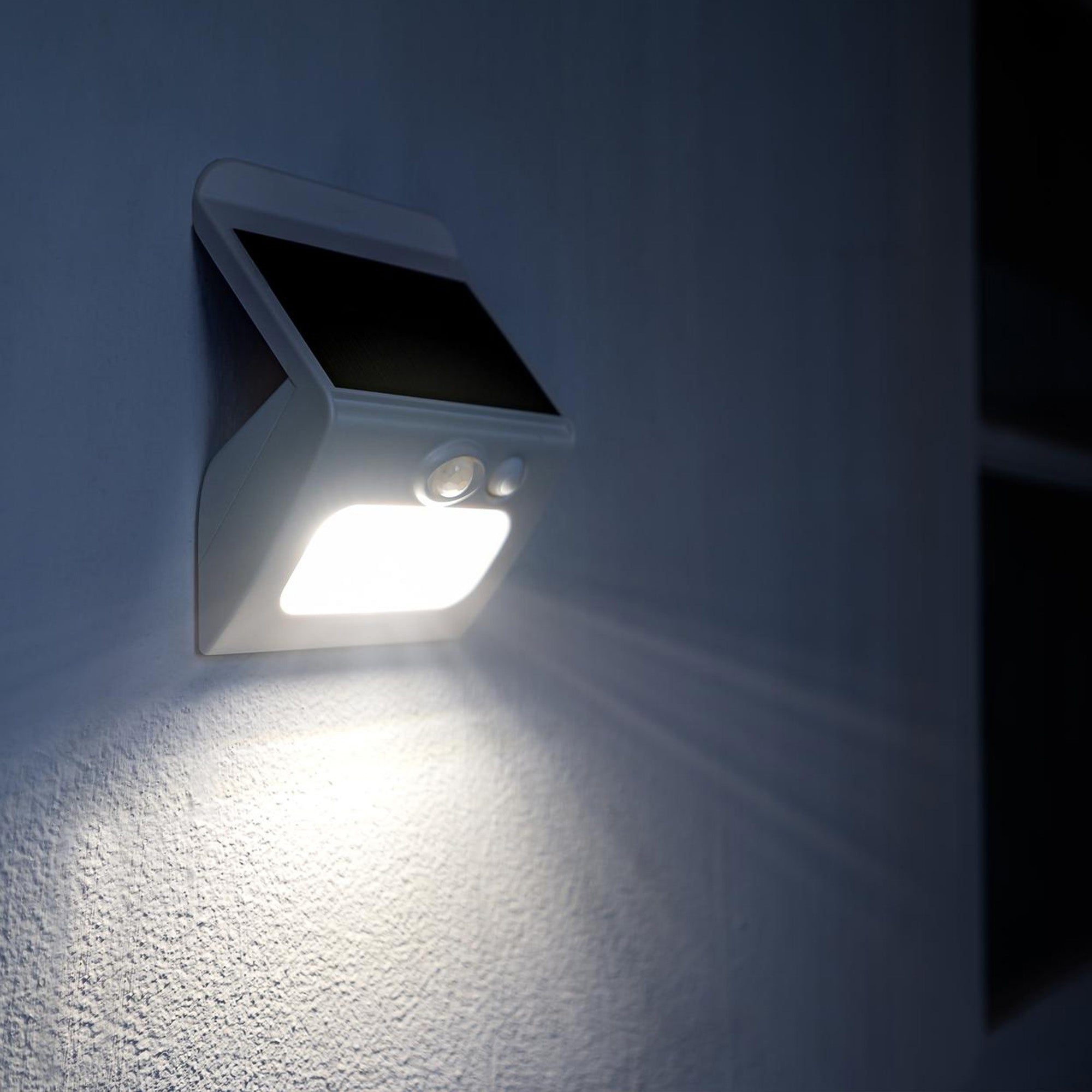
For outdoor areas with similar needs, the KASTLITE LED Solar Powered Flood Light combines motion sensing with solar power for zero-electricity-cost operation.
Upgrade Path 3: Daylight Harvesting
Daylight harvesting uses photosensors to dim or turn off electric lights when enough natural light enters a space. This works best in perimeter zones near windows and skylights.
How It Works
A photosensor mounted on the ceiling measures ambient light levels. When natural light exceeds the setpoint (typically 30-50 foot-candles for office work), the controller dims the electric lights proportionally. On a bright day, perimeter lights might dim to 20% output or shut off entirely.
Savings Potential
Daylight harvesting saves 20-40% of lighting energy in zones within 15 feet of windows, according to the New Buildings Institute. For a small office with a window-heavy layout, this can translate to $200-600 per year in electricity savings.
Requirements
- Dimmable LED fixtures or drivers (most modern LEDs are dimmable)
- Photosensors ($50-150 each, one per zone)
- Compatible dimming controller ($100-300 per zone)
The initial investment runs $200-500 per zone, with payback in 1-3 years depending on window orientation and local electricity rates.
Upgrade Path 4: Timer and Scheduling Controls
Simple timer switches and programmable schedules prevent lights from running during closed hours. This is the most overlooked upgrade. I have walked through small business buildings at 11 PM and seen entire floors lit up because nobody flipped the switch on the way out.
Options
- Mechanical timers: $15-30. Set on/off times. Simple and reliable
- Digital programmable timers: $30-80. Multiple on/off events per day, weekend/weekday schedules
- Smart switches (Wi-Fi enabled): $40-100. Control from a phone app, set schedules remotely, monitor energy use
- Astronomical timers: Automatically adjust on/off times to sunrise and sunset. Best for outdoor signage and parking lot lighting
Savings Example
A small business that accidentally leaves exterior parking lot lights on from 6 AM to 8 PM (14 hours) when they only need them from dusk to 11 PM (about 5 hours) wastes 64% of its outdoor lighting electricity. A $30 timer switch pays for itself in 2-3 weeks.
For completely automated outdoor lighting that needs no timer, KASTLITE offers dusk-to-dawn fixtures with built-in photocells:
- Solar-powered lights for parking areas and pathways (zero electricity cost)
- LED security lighting with built-in sensors for building perimeters
Upgrade Path 5: Better Light Diffusion
Poor light distribution creates a hidden energy problem. When fixtures produce harsh, uneven light, building managers often respond by adding more fixtures, doubling the energy cost. The smarter solution is better diffusion from existing fixtures.
How Diffusers Save Energy
A prismatic lens or frosted diffuser panel spreads light evenly across a larger area, reducing hotspots and dark zones. With proper diffusion, you often need fewer fixtures to achieve the same average light level. Removing even 2-3 redundant fixtures from a 20-fixture room saves 10-15% on energy.
Recommended Diffuser Upgrades
- KASTLITE Acrylic Prismatic Panels: Excellent light control for offices, classrooms, and retail. 92% light transmission through UV-stabilized acrylic
- Polycarbonate Prismatic Panels: High-impact option for warehouses, gyms, and industrial spaces
- Wraparound lenses (DLB/DSB): Replace yellowed, cloudy wraparound covers to restore full light output and reduce the need for supplemental fixtures
How to Calculate Your Lighting ROI
Use this formula to estimate the payback period for any lighting upgrade:
Annual energy savings = (old watts - new watts) x number of fixtures x hours per year / 1,000 x electricity rate per kWh
Payback period = total upgrade cost / annual savings
Worked Example
A restaurant replaces 30 fluorescent 32W T8 tubes with 18W LED tubes.
- Watt reduction per tube: 14W
- Total watt reduction: 420W
- Operating hours: 4,380/year (12 hrs/day, 365 days)
- kWh saved: 420 x 4,380 / 1,000 = 1,840 kWh
- Savings at $0.14/kWh: $258/year
- Cost (30 tubes at $10 each): $300
- Payback: 14 months
Add occupancy sensors to the restrooms and storage room (saving another $100-150/year), and the combined payback drops below 12 months.
Utility Rebates and Tax Incentives
Most U.S. utility companies offer rebates for commercial LED upgrades. According to EcoLED Mart, 75% of U.S. commercial facilities have access to active rebate programs covering $25-150 per fixture as of 2026. Combined with Section 179D tax deductions, incentives can offset 20-50% of the total project cost.
Check your utility provider's website or the DSIRE database (dsireusa.org) for programs in your area.
Implementation Checklist for Small Business Owners
- Audit current fixtures: Count fixtures, note bulb types and wattages, and calculate monthly lighting kWh from your electricity bill
- Prioritize by payback speed: LED retrofit first (fastest payback), then occupancy sensors, then timers, then daylight harvesting
- Check for rebates: Contact your utility provider before purchasing. Some rebates require pre-approval
- Start with high-use areas: Upgrade the spaces that run lights the most hours per day first
- Track results: Compare electricity bills month-over-month after each upgrade to verify savings
Ready to start your lighting upgrade? Explore these KASTLITE resources: