
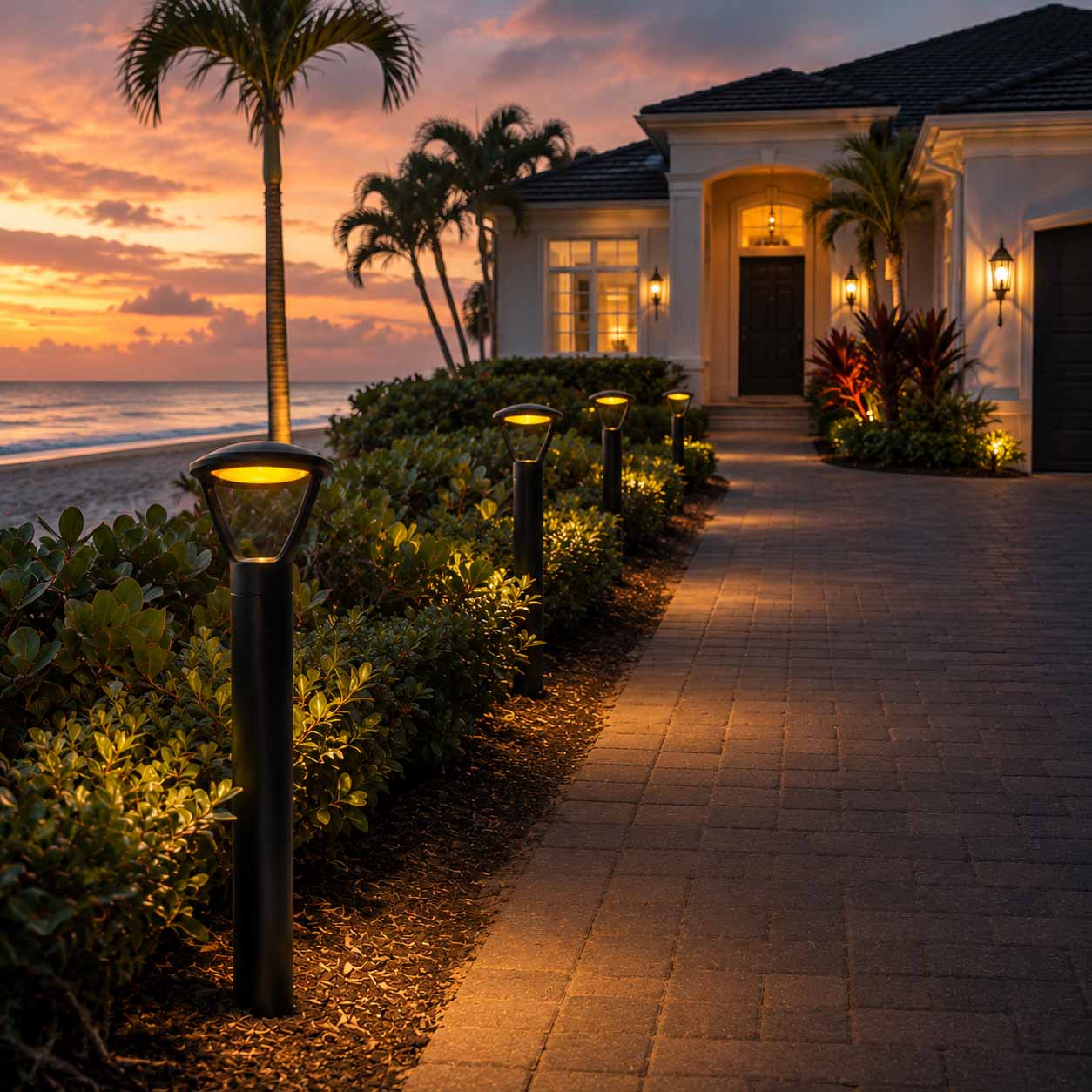
A house can have fresh paint, trimmed hedges, and a new front door, and still look flat the moment the sun goes down. Decorative lighting is what carries curb appeal past sunset. It shapes the first impression a buyer, guest, or delivery driver gets of a property, and it does that job every single evening, not just on the day of a listing photo shoot.
This matters more than most homeowners realize. According to the National Association of REALTORS®, 92% of real estate agents recommend that sellers improve curb appeal before listing a home, and nearly all agents consider curb appeal important for attracting buyers. Lighting is one of the few upgrades that improves how a property looks, feels, and functions at the same time. This guide walks through why decorative lighting affects property value, which fixture types make the biggest difference, and how to plan a layout that looks intentional instead of accidental.
Why Decorative Lighting Affects Curb Appeal
Curb appeal is really a first-impression test. A buyer or visitor decides how they feel about a property within seconds, often before they get out of the car. During the day, landscaping and architecture carry that impression. After dark, lighting is the only thing doing the work.
Well-placed lighting does three things at once:
-
It highlights the good stuff. A lit walkway, an illuminated house number, or a glowing entryway draws the eye toward the features you want noticed.
-
It signals upkeep. A property with clean, working, well-aimed lighting reads as cared for. A property with a burned-out porch light or a bare bulb over the garage reads as neglected, even if nothing else is wrong.
-
It adds a safety layer. Lit steps, driveways, and walkways reduce trip hazards and give visitors confidence walking the property at night.
None of this requires a dramatic lighting design. A few thoughtfully placed fixtures, chosen for the right job, usually beat an overlit yard with mismatched bulbs.
The Property Value Connection
The link between outdoor lighting and resale value is not just a landscaper's talking point. It shows up in real estate industry data.
According to NAR's curb appeal research, outdoor lighting and pathways are treated as a meaningful part of how a home presents itself in the marketplace, right alongside porches and landscaping. Realtors surveyed for NAR's Remodeling Impact Report also identified the specific lighting upgrades homeowners commonly make before selling, led by landscape lights, along with porch and garage sconces, since these fixtures are inexpensive relative to their effect on how a home shows.
It is worth being precise here: lighting alone rarely determines a sale price. What it consistently does is improve perceived value and buyer confidence, which supports stronger offers and faster showings, especially for evening walk-throughs or listing photos taken at dusk. Pair that with the safety and security benefits, and lighting becomes one of the better dollar-for-dollar exterior upgrades available, well ahead of larger renovations in terms of cost.
There is also an efficiency argument. LED exterior lighting uses a fraction of the electricity that older incandescent or halogen fixtures need. According to the U.S. Department of Energy, the average household saves about $225 a year in energy costs by switching to LED lighting, and outdoor fixtures that run for long hours each night are exactly where those savings add up fastest. Upgrading old fixtures to LED is a curb appeal improvement and a utility bill improvement in the same project.
Five Decorative Lighting Types That Make the Biggest Difference
Not every fixture pulls its weight equally. These five categories consistently show up in curb appeal upgrades because each one solves a different lighting problem.
1. Bollards

Bollard lights are short, post-mounted fixtures that sit low along driveways, walkways, and garden beds. They give a property a clean, architectural look without the visual bulk of a tall lamp post, and they work well lining a path to a front door or marking the edge of a driveway.
Modern LED bollards, like the AmberLED Aeroform Bollards from KASTLITE, pair a sleek round or square housing with a sealed, weatherproof LED array rated for wet locations. This particular design uses monochromatic amber light in the 585 to 595 nanometer range, which makes it a strong fit for coastal properties or dark-sky communities that restrict white light near shorelines or natural areas. For most homeowners, a well-placed run of bollards along a front walk does more for evening curb appeal than a single oversized floodlight ever will.
2. Lamp Post Globes

Globe-topped lamp posts are one of the most recognizable pieces of residential exterior lighting, and for good reason. They sit at the entrance to a driveway or front yard, and they set the tone for the entire property before anyone reaches the door. A cracked, yellowed, or mismatched globe undercuts an otherwise well-kept exterior fast.
Replacing an old globe is usually simpler and cheaper than replacing the whole fixture. KASTLITE's lamp post globes come in sizes from 6 inches to 20 inches, in fitter neck, screw neck, and neckless styles, made from impact-resistant acrylic that resists the yellowing that plagues older glass and plastic globes. For a straightforward upgrade, the 16" Globe with 8" Fitter Neck fits most standard post-top fixtures, and the 16" Premium Lamp Post Globe Combo bundles the globe, fitter, and an adjustable LED bulb into one complete fixture for a 3-inch pole.
3. Wall Sconces
 Wall sconces do the close-range work: flanking a front door, lighting a side entrance, or marking a garage. They are one of the most common outdoor lighting upgrades homeowners make before selling, largely because they are affordable, easy to install, and immediately visible to anyone approaching the house.
The goal with sconces is balance. Two matching sconces at the same height on either side of a door reads as intentional. A single mismatched fixture reads as an afterthought. KASTLITE's wall-mounted fixtures include weatherproof, corrosion-resistant options suited to entryways, garages, and coastal exposure, including the Wall Mount Porch/Front Door Light Fixture, a UL-listed plastic sconce with a prismatic or opal acrylic diffuser, and the Round Outdoor LED Bulkhead Light Fixture, an ENERGY STAR-rated option that works equally well flush-mounted on a wall or ceiling.
4. Spot and Flood Lights
 Spot and flood lights carry the heavier lifting: washing light across a facade, illuminating a driveway, or covering a side yard for security. Used well, they highlight architectural details, like a stone chimney or a covered porch, without turning the whole yard into a stadium.
The key mistake to avoid is glare. A flood light aimed straight at eye level from across the yard creates harsh shadows and blinds visitors instead of welcoming them. Aim fixtures down and slightly outward, and choose a wattage matched to the area. A 15W to 25W flood light generally covers a residential driveway or garage entry without overpowering it, while larger areas need proportionally more output. KASTLITE's 15W Twin-Head Directional Outdoor Photocell LED Flood Light fits this residential range well, with a built-in photocell for automatic dusk-to-dawn operation, and the full security lighting collection covers everything from side-yard accents to larger area lights.
5. LED Deck and Step Lights
 Deck and step lights solve a problem the other categories do not: they light the ground itself. Recessed or surface-mounted step lights along a staircase, deck edge, or paver walkway prevent the kind of trip hazard that shows up right after dark, when depth perception drops and shadows hide uneven surfaces.
These fixtures also add a layer of visual interest that reads as high-end without much cost. A staircase with a soft glow along each tread looks considerably more finished than one lit only by a porch light overhead. Low-voltage LED step lights are inexpensive to run and typically last well beyond traditional incandescent options.
How to Layer Decorative Lighting So It Looks Intentional
A common mistake is treating exterior lighting as one decision instead of several. The most convincing curb appeal lighting uses layers:
1. Path and grade lighting (bollards, step lights) to guide movement and mark elevation changes.

2. Entry lighting (wall sconces, post lights) to frame the front door and any secondary entrances.

3. Accent lighting (spot and flood fixtures) to highlight architecture, trees, or a garage.

4. A consistent color temperature. Mixing a cool 5000K floodlight with warm 2700K sconces makes a property look unfinished, even if each fixture is individually attractive. Warm white, in the 2700K to 3000K range, is the standard choice for residential curb appeal because it reads as inviting rather than clinical.

A simple test: stand at the curb after dark and look at the property the way a visitor would. If your eye is drawn to the door, the walkway, and the architecture, in that order, the layout is working. If your eye is drawn to a single glaring fixture, it needs to be re-aimed or swapped for a lower output.
Why Choose KASTLITE
KASTLITE has spent years supplying outdoor lighting components and fixtures built to hold up outside, not just look good in a showroom. That shows up in the details: sealed LED compartments, wet-location listings, UV-stabilized lenses, and finishes designed to resist corrosion in coastal or high-humidity climates. Whether the project is a full bollard installation along a new walkway or a simple globe swap on an aging lamp post, KASTLITE builds each fixture to survive years of nightly use outdoors, backed by a manufacturer warranty and support from a team that knows the products. Homeowners, contractors, and property managers can find fixtures sized and finished for the specific job, instead of settling for a generic big-box option.
Conclusion
Decorative lighting is one of the few home improvements that pays off in three ways at once: it improves how a property looks after dark, it adds a real safety benefit for anyone walking the property at night, and it consistently ranks among the exterior upgrades real estate professionals recommend before a sale. The fixtures don't need to be elaborate. A run of bollards along the walkway, a matched pair of wall sconces at the door, a properly aimed flood light, and a few step lights on the stairs cover most of what a property needs.
Ready to upgrade your exterior lighting? Browse KASTLITE's full lighting collection or start with the AmberLED Aeroform Bollards to bring a clean, modern look to your front walk. Have questions about which fixtures fit your property? Contact the KASTLITE team or browse more lighting guides on the KASTLITE blog.
Frequently Asked Questions
Does outdoor lighting actually increase home value?
Outdoor lighting doesn't guarantee a higher appraisal on its own, but it consistently improves perceived value and buyer confidence. Real estate professionals widely recommend curb appeal upgrades, including lighting, before listing a home, since a well-lit exterior photographs better and shows better during evening visits.
What color temperature should I use for decorative outdoor lighting?

Warm white, generally in the 2700K to 3000K range, is the standard for residential curb appeal. It reads as inviting and complements brick, wood, and most siding colors. Cooler temperatures above 4000K tend to look more commercial or clinical for a home exterior, though they can work well for security-focused flood lighting.
How many bollard lights do I need for a walkway?
A common approach is to space bollards 6 to 10 feet apart along a walkway, staggering them on alternating sides if the path is wide enough. Shorter spacing works better for winding paths or steps, while longer spacing suits straight driveways.
Are LED fixtures worth the extra upfront cost compared to older bulb types?
Yes, in most cases. LED fixtures use significantly less energy and last far longer than incandescent or halogen options, so the higher upfront cost is typically recovered through lower electricity bills and fewer bulb replacements over the fixture's lifespan.
Can decorative lighting be dark-sky friendly?

Yes. Fully shielded, downward-directed fixtures with warm color temperatures reduce light spilling upward or outward, which cuts glare and light pollution. This matters most for properties near coastlines, wildlife habitats, or in communities with dark-sky lighting ordinances, where amber or long-wavelength LEDs are often required.
What's the difference between a wall sconce and a bollard for entryway lighting?
A wall sconce mounts directly to the house or garage and lights a specific vertical surface, like a door or garage entrance. A bollard is a freestanding, low-profile post light used along paths and driveways at ground level. Most entryways benefit from using both: sconces to frame the door and bollards to light the approach.