
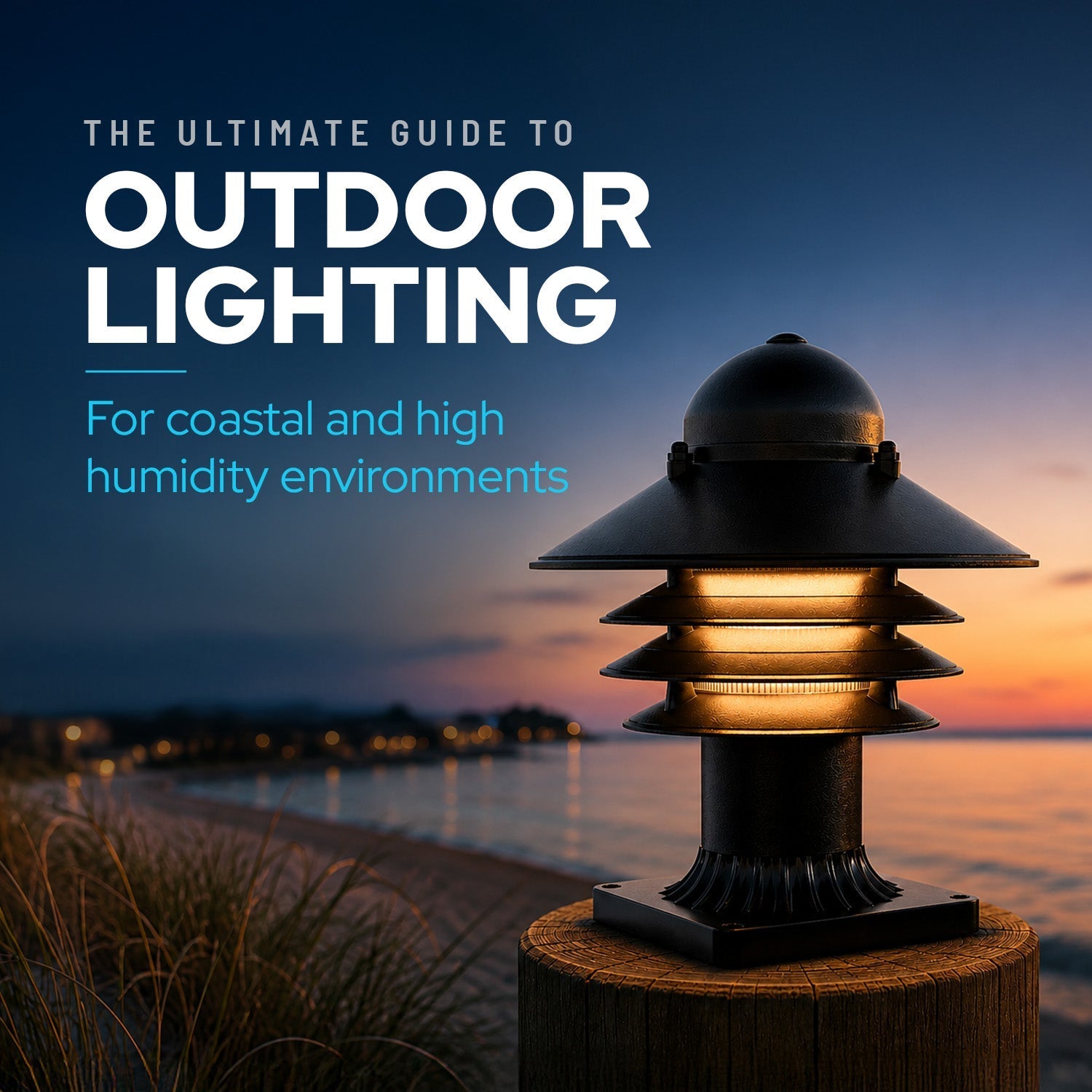
Salt air does not just wear outdoor lighting fixtures down, it attacks them. Metal housings pit and rust, lenses fog, and electrical components fail years before their inland counterparts show any wear. Choosing the right outdoor lighting for coastal environments comes down to three things: the housing material, the IP rating, and, in much of Florida, sea turtle lighting regulations that carry real legal weight.
Why Coastal Air Destroys Ordinary Fixtures

Salt is an electrolyte, so it accelerates corrosion on metal housings and electrical contacts far faster than plain moisture. High humidity works its way into seals and gaskets, leading to fogged lenses and corroded sockets. Constant sun and heat cycling also stress plastics and seals, causing lower-grade materials to crack and yellow early. These three forces (salt, humidity, and UV) hit coastal fixtures at the same time, which is why gear that holds up fine inland often fails within a season near the water.
IP Ratings: What You Need
An IP rating (Ingress Protection rating) tells you how well a fixture resists dust and water.
-
IP65: Is the minimum for most exposed coastal fixtures (wall packs, post tops, pier mounts)
-
IP66: Offers stronger protection against fixtures facing sprinklers, wave spray, or regular washdown
-
IP67: Withstands temporary submersion, ideal for ground-level fixtures after storms
An IP rating doesn't guarantee corrosion resistance. A fixture can be IP66-rated and still rust quickly if it's built from untreated metal, so rating and material need to be evaluated together.
Materials That Hold Up Near Salt Water
-
Polycarbonate: Contains no metal, so it can't rust or pit. UV-stabilized versions resist yellowing and stay clear for years. This is the backbone of most of KASTLITE's nautical fixtures.
-
316 marine-grade stainless steel: Contains molybdenum, which resists chloride pitting far better than standard 304 stainless. Good for hardware and brackets exposed to direct spray.
-
Powder-coated aluminum: Seals metal from moisture, but only when the coating itself is rated for coastal exposure, not all of it is.
-
Avoid: untreated steel, plain chrome/plated finishes, and standard plastics without UV stabilizers. If a spec sheet doesn't mention corrosion resistance or a specific IP rating, treat that as a red flag.
Sea Turtle-Friendly Lighting Is a Legal Requirement, Not a Preference

If your property sits near a Florida nesting beach, lighting isn't just aesthetic. The FWC's "Low, Long, Shielded" standard requires fixtures mounted low, using long-wavelength light above 560 nanometers (amber, orange, or red LEDs), and fully shielded so the lamp is never directly visible. Warm white LEDs at 2700K-3000K still don't qualify, they emit enough short-wavelength light to disorient hatchlings.
KASTLITE's Sea Turtle & Coastal collection is built to this standard:
-
Polycarbonate Turtle Light Wall Sconce, from $119.90
-
Polycarbonate Wall Sconce, from $49.99
-
AmberLED Path Light-$295.00
-
AmberLED Aeroform Bollards-$595.00
-
AmberLED B11Q Side Light Bollard-$795.00
-
LED-8101-AMB Outdoor SOX Lamp Replacement-$139.99 (retrofit bulb for existing SOX fixtures)
Requirements vary by county. See our full Sea Turtle Friendly Lighting Compliance Report for specifics.
Maintenance Tips to Extend the Life of Coastal Lighting
Even the best-built fixtures benefit from routine care in salt air. A few habits go a long way:
-
Rinse fixtures periodically with fresh water to remove accumulated salt residue, especially after storms or high-wind days.
-
Inspect gaskets and seals on any fixture rated IP65 or higher at least once a year, since worn seals reduce the fixture's real-world water resistance even if the original IP rating hasn't changed.
-
Check mounting hardware for corrosion, particularly if the fixture housing is polycarbonate but the brackets or screws are standard steel.
-
Replace cloudy or yellowed lenses rather than waiting for full fixture failure. UV-stabilized polycarbonate resists this, but lower-grade plastics degrade faster and should be swapped out early.
Frequently Asked Questions
What IP rating do I need for coastal outdoor lighting?
IP65 is a practical minimum for most exposed coastal fixtures, protecting against dust and low-pressure water jets. Fixtures facing direct wave spray, sprinkler exposure, or regular washdown should be rated IP66 or higher.
Is polycarbonate better than metal for coastal lighting?
For corrosion resistance, yes. Polycarbonate cannot rust or pit the way untreated metal can, which is why it is widely used for coastal and marine-grade fixtures. Marine-grade 316 stainless steel and properly powder-coated aluminum are strong metal alternatives when a metal finish is required.
Do I legally need turtle-friendly lighting on my Florida property?
If your property is within a sea turtle nesting habitat or subject to Coastal Construction Control Line or Environmental Resource permitting, turtle-friendly lighting is typically a regulatory requirement, not an option. Requirements vary by county, so check local ordinances or review our Sea Turtle Friendly Lighting Compliance Report for details.
Can I just use warm white LEDs instead of amber ones near a nesting beach?
No. Warm white LEDs at 2700K or 3000K still emit meaningful short-wavelength light that can disorient sea turtles, even though they appear warm to the human eye. FWC guidance requires true amber, orange, or red diodes at 560nm or longer, not filtered or tinted white LEDs.
How often should I inspect coastal lighting fixtures?
At minimum, inspect fixtures annually for gasket wear, corrosion at mounting points, and lens clarity. Properties directly on the water or in high-salt zones benefit from a semi-annual check, especially after hurricane season.