
The Ocean Is Right There. They Just Can't Find It.
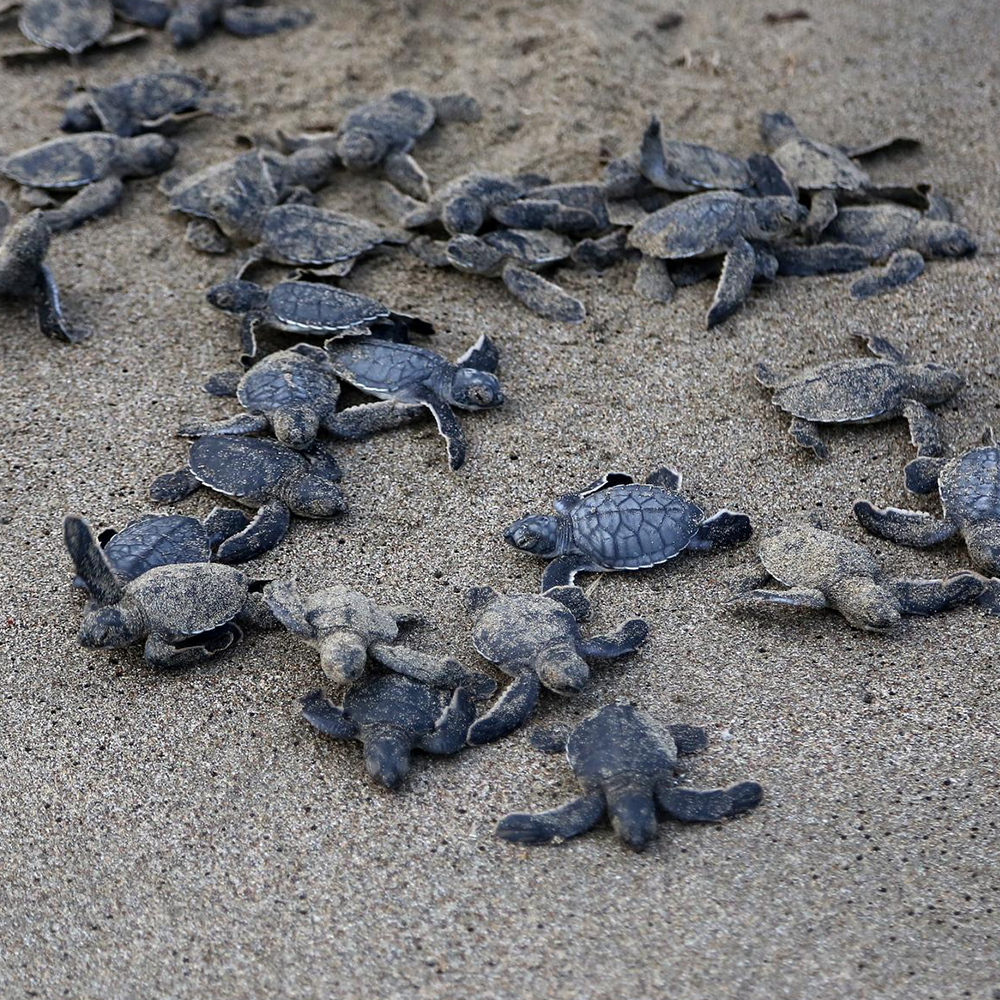
A sea turtle hatchling emerges from the sand at night with one job: reach the water.
It has no mother to guide it. No map. No instinct beyond a single, ancient biological cue move toward the brightest, widest light on the horizon. For over 100 million years, that light was always the ocean. The open sky over the water reflects more light than the dark silhouette of dunes and vegetation behind the beach. The hatchling follows it. It works perfectly.
Until we started building things on the coast.
Today, the brightest light on many Florida beaches doesn't come from the ocean it comes from hotels, streetlamps, restaurants, and the glow of homes. And for a hatchling that weighs less than an ounce and has never seen anything before in its life, that glow is irresistible and fatal.
Artificial light at night (ALAN) is now recognized by scientists and conservation agencies worldwide as one of the most serious threats to sea turtle survival and one of the most preventable. Here's what the research tells us, and why it matters right now.
How Sea Turtles Use Light And Why It Makes Them Vulnerable
To understand the threat, you have to understand the navigation system.
Sea turtles are primarily nocturnal nesters. Female turtles come ashore at night to lay eggs, using darkness as cover from predators. When hatchlings emerge typically 45 to 70 days later, also at night they use what researchers call the "brightest unobstructed horizon" as their compass. The open ocean horizon reflects ambient sky glow and starlight, creating a naturally brighter seaward direction compared to the darker landward side, blocked by dunes and vegetation.
Hatchlings move toward the center of the brightest horizon with low light across a broad span — it's a built-in orientation system that's worked flawlessly for millions of years.
The problem is that artificial lighting completely overrides this instinct. Artificial lights on sea turtle nesting beaches can deter female turtles from nesting and can disorient both females and their hatchlings on their way to the sea.
There is no override switch. There is no learning curve. A hatchling that sees a parking lot light brighter than the ocean will walk toward the parking lot and it will keep walking until it dies of exhaustion, gets eaten by predators, or is hit by a car.
The Scale of the Problem in Florida
Florida is ground zero for this issue. It hosts some of the most important sea turtle nesting beaches in the Western Hemisphere. Loggerheads, green turtles, and leatherbacks all nest along its Atlantic and Gulf coasts from March through October. It is also one of the most densely developed coastal states in the country.
The collision between those two realities is devastating.
Disorientation from artificial lighting causes thousands of hatchling deaths each year in Florida and is a significant marine turtle conservation problem. The Florida Fish and Wildlife Conservation Commission (FWC) runs an annual statewide monitoring program specifically dedicated to tracking disorientation incidents, a program that exists precisely because the problem is large enough to require its own infrastructure.
The threat doesn't stop at the shoreline, either. 98% of sea turtle nesting areas in the United States are exposed to some level of light pollution. That number is not a warning sign. It's an emergency.
It Affects Mothers, Not Just Hatchlings
Most conversations about light pollution focus on hatchlings and for good reason. But the threat begins before the eggs are even laid.
Nesting female sea turtles are highly sensitive to light during the nesting process. When they approach a beach to lay eggs and encounter bright artificial lighting, many will turn back to the ocean without nesting at all. This is called a "false crawl" the female comes ashore, senses the light, and retreats. No nest. No eggs. No hatchlings.
Repeated false crawls exhaust the female and reduce the number of successful nests per season. In heavily lit areas, females may abandon nesting attempts on familiar beaches they've used for decades, further concentrating nesting pressure on smaller, darker stretches of coast or skipping nesting opportunities altogether.
Artificial light at night impacts sea turtle nesting around the globe by decreasing nesting attempts, disorienting hatchlings while trying to find the sea, and disrupting hatchlings' offshore migration.
The effects compound across generations. Fewer nests mean fewer hatchlings. Fewer hatchlings mean smaller populations. Smaller populations mean less resilience against all the other threats sea turtles face.
What Happens to a Disoriented Hatchling
The path from nest to ocean is already one of the most dangerous journeys in nature. Hatchlings face predation from ghost crabs, birds, and fish the moment they enter the water. But disorientation from artificial light multiplies those risks dramatically.
A hatchling moving away from the ocean instead of toward it faces:
Exhaustion and dehydration. Hatchlings carry just enough energy reserves to reach the water and begin feeding. Walking in the wrong direction for hours depletes those reserves. Many never recover.
Increased predation. Moving inland exposes hatchlings to a wider range of terrestrial predators raccoons, foxes, and birds for a much longer period than the brief beach crossing was ever designed to be.
Road mortality. In developed coastal areas, disoriented hatchlings frequently end up on roads and are killed by vehicles. This was, in fact, the founding tragedy of Sea Turtle Oversight Protection (S.T.O.P.) co-founder Siouxzen WhiteCloud witnessed hundreds of baby loggerhead turtles dead in the road, led there by streetlights, and knew something had to change.
Offshore disorientation. Artificial lights can interfere with hatchlings' ability to head in the right direction once in the water, making them susceptible to higher levels of predation, as well as exhaustion and dehydration. The threat doesn't end at the waterline.
The Economic and Ecological Ripple Effects
Sea turtles are not isolated creatures. They are keystones of the coastal ecosystems they inhabit and their absence creates cascading damage that extends far beyond the beach.
Green sea turtles graze on seagrass, keeping beds healthy and productive. Loggerheads prey on jellyfish and crabs, regulating those populations. Sea turtle nests themselves the unhatched eggs and shells left behind fertilize coastal dune vegetation. Remove the turtles, and you begin to unravel the fabric of the ecosystem they support.
The economic case is just as clear. Around 1,800 sea turtles lost due to light pollution conditions translates into an estimated economic loss of up to $288 million, according to recent research accounting for the value of ecotourism, ecosystem services, and conservation investment. Coastal communities that profit from healthy beaches and marine wildlife have a direct financial stake in solving this problem.
The Good News: This Is Fixable
Unlike climate change, bycatch mortality, or ocean plastic all serious, complex, systemic problems artificial light pollution is one of the most solvable threats facing sea turtles today.
The solution is not darkness. It's better light.
Artificial lighting that can confuse baby turtles trying to find the ocean has been reduced or removed in many locations, contributing to measurable population recoveries in well-monitored areas. Where turtle-safe lighting ordinances have been implemented and enforced, disorientation incidents drop sharply.
Turtle-friendly lighting works on a simple principle: sea turtles are most sensitive to short-wavelength light (white, blue, and green tones). Amber and long-wavelength LEDs fall largely outside their visual spectrum which means a properly designed amber LED fixture can illuminate a beachfront home, deck, or business effectively while being nearly invisible to nesting females and hatchlings navigating the shore.
The Florida Department of Environmental Protection and the Florida Fish and Wildlife Conservation Commission worked with DarkSky International to identify coastal lighting threatening sea turtle nesting habitats and develop turtle-friendly lighting recommendations now being implemented across the state.
The tools exist. The science is clear. What's needed now is adoption.
What You Can Do Right Now
If you live near, own property near, or manage a business on Florida's coast, these steps have an immediate, measurable impact:
Switch to turtle-safe amber LED lighting for any outdoor fixtures visible from the beach or shoreline wall sconces, porch lights, landscape lighting, and signage. Products like the Kastlite Turtle-Safe Amber LED Wall Sconce and AmberLED Low Profile Pathway Bollard are Florida Wildlife Conservation-approved and Dark Sky-certified, delivering full illumination without the harmful spectrum.
Shield and redirect existing lights so they point downward and away from the beach rather than broadcasting broadly toward the shoreline.
Close curtains and blinds on beach-facing windows after dark during nesting season (May–October).
Support organizations doing the work on the ground. Sea Turtle Oversight Protection (S.T.O.P.) is a volunteer-led Florida nonprofit that patrols Fort Lauderdale beaches every night during nesting season monitoring nests, rescuing disoriented hatchlings, and holding the line against a threat that most people drive past without ever knowing it's there.
Every responsible choice made by a coastal homeowner or business removes one more obstacle between a hatchling and the ocean it was born to reach.
The Light Between Life and Loss
Sea turtles have survived ice ages, continental drift, and mass extinctions. They are, in the most literal sense, survivors of deep time. What they are not equipped to survive — without our help — is a coastline that glows brighter than the sea itself.
The threat is real. The scale is enormous. And the fix is, in many cases, a single lightbulb.
That's not a small thing. That's an invitation.
Ready to make the switch? The Kastlite Turtle-Safe Amber LED Wall Sconce is available at Kastlite.com with 12% of profits supporting Sea Turtle Oversight Protection's conservation work on Florida's nesting coastline.
To volunteer, donate, or learn more about light pollution and sea turtle conservation, visit seaturtleop.org.
Frequently Asked Questions
Why are sea turtles so affected by artificial light?
Sea turtles navigate by orienting toward the brightest horizon a system that reliably points toward the open ocean under natural conditions. Artificial light on land creates a competing brightness that overrides this instinct, pulling hatchlings and nesting females away from the water rather than toward it. Because this navigation system is hardwired and instinctive, turtles have no ability to distinguish safe from dangerous light sources.
Does light pollution affect adult sea turtles too?
Yes. Nesting females are highly sensitive to artificial lighting during the nesting process. Bright lights can cause them to abort nesting attempts entirely returning to the ocean without laying eggs. Over a nesting season, repeated disruptions reduce the number of successful nests and add physical stress to females who have already traveled hundreds of miles to reach their home beach.
What wavelengths of light are safest for sea turtles?
Long-wavelength amber and red LEDs (roughly 580nm and above) fall largely outside the visual spectrum that sea turtles respond to. Short-wavelength white, blue, and green lights are the most disorienting. Florida Wildlife Conservation-approved turtle-safe fixtures use amber LEDs specifically because of this spectral difference.
Is turtle-friendly lighting legally required in Florida?
Florida law requires beachfront and coastal properties to use sea turtle-friendly lighting during nesting season. The Florida Fish and Wildlife Conservation Commission issues guidance on compliant lighting types, and local ordinances in many coastal counties add additional requirements. Penalties for non-compliance can include fines and required remediation.
How can I tell if my outdoor lighting is turtle-safe?
Look for fixtures that are Florida Wildlife Conservation-approved, Dark Sky certified, and use long-wavelength amber LEDs rather than standard white or daylight-spectrum bulbs. The fixture should also direct light downward and inward away from the beach to minimize light trespass toward the shoreline.
Sources: Florida Fish and Wildlife Conservation Commission (FWC), State of the World's Sea Turtles (SWOT), NOAA Fisheries, ScienceDirect, DarkSky International, Sea Turtle Oversight Protection (S.T.O.P.)