
Poorly lit parking lots and pathways cause slip-and-fall injuries, vehicle accidents, and property crime. According to the International Parking and Mobility Institute, inadequate lighting is a contributing factor in the majority of parking facility liability claims. The solution is not simply more light. It is the right amount of light, placed correctly, with uniform distribution and minimal glare. For more information, see the Illuminating Engineering Society (IES).
This guide covers actual IES illumination standards (with specific foot-candle numbers), pole height and spacing recommendations, fixture selection, and the KASTLITE products that meet these requirements.
IES RP-20 Parking Lot Lighting Standards
The Illuminating Engineering Society (IES) publishes RP-20, the standard for lighting in parking facilities. These are the numbers that architects, engineers, and code officials reference. Here are the recommended horizontal illuminance levels:
Open Parking Lots (Uncovered)
| Zone | Horizontal Avg (fc) | Range (fc) | Vertical Avg (fc) | Uniformity (max:min) |
|---|---|---|---|---|
| Urban (Zone 3) | 1.5 | 0.75 - 3.0 | 0.8 | 20:1 |
| Suburban (Zone 2) | 1.0 | 0.5 - 2.0 | 0.6 | 20:1 |
| Rural (Zone 1) | 0.5 | 0.25 - 1.0 | 0.3 | 20:1 |
Covered Parking (Garages)
| Area | Horizontal Avg (fc) | Uniformity (max:min) |
|---|---|---|
| General parking | 1.5 | 10:1 |
| Ramps and corners | 3.0 | 10:1 |
| Entrance/exit (daytime) | 50.0 | 10:1 |
| Stairwells | 5.0 | - |
Enhanced Security Areas
When a parking facility serves areas with higher security concerns (hospitals, transit stations, late-night retail), IES recommends increased levels:
- Minimum horizontal illuminance: 0.5 foot-candles
- Minimum vertical illuminance: 0.25 foot-candles (critical for facial recognition by security cameras)
- Tighter uniformity ratio: 15:1 maximum-to-minimum
Note: "Foot-candle" (fc) measures the light hitting a surface. One foot-candle equals one lumen per square foot. Vertical illuminance (light on vertical surfaces like faces and signs) matters as much as horizontal illuminance (light on the ground) for security applications.
Pathway and Pedestrian Lighting Standards
IES RP-8 covers roadway and pedestrian pathway lighting. The recommended levels for walkways depend on the surrounding area classification:
| Pathway Type | Avg Horizontal (fc) | Min Horizontal (fc) | Uniformity (avg:min) |
|---|---|---|---|
| Commercial/urban walkway | 1.0 - 2.0 | 0.5 | 4:1 |
| Residential walkway | 0.5 - 1.0 | 0.2 | 4:1 |
| Park/recreational path | 0.5 | 0.1 | 4:1 |
| Building entrance | 5.0 | 1.0 | - |
Pathways require tighter uniformity (4:1) than parking lots (20:1) because pedestrians need consistent visibility at eye level to detect trip hazards, steps, and changes in surface grade.
Pole Height and Spacing Guidelines
Getting pole height and spacing right determines whether your installation meets the standards above. Here are general guidelines based on common practice and IES recommendations:
Parking Lot Poles
| Pole Height | Typical Spacing | Coverage Area per Fixture | Best For |
|---|---|---|---|
| 12-15 feet | 30-40 feet apart | 900-1,600 sq ft | Small lots, 20-50 spaces |
| 20-25 feet | 50-70 feet apart | 2,500-4,900 sq ft | Medium lots, 50-200 spaces |
| 25-35 feet | 70-100 feet apart | 4,900-10,000 sq ft | Large commercial lots |
Pathway Poles and Bollards
| Fixture Height | Typical Spacing | Coverage Width | Best For |
|---|---|---|---|
| 3-4 feet (bollard) | 15-25 feet apart | 6-10 feet | Garden paths, residential walkways |
| 8-12 feet (post top) | 30-50 feet apart | 15-25 feet | Commercial walkways, campus paths |
| 12-15 feet (post top) | 40-60 feet apart | 20-35 feet | Parking lot pedestrian routes, plazas |
Rule of thumb: Spacing between poles should not exceed 4 times the mounting height for most post-top fixtures. So a 12-foot pole should have fixtures spaced no more than 48 feet apart.
How to Calculate Lumen Requirements
To figure out how many lumens each fixture needs to produce, use this formula:
Required lumens per fixture = target foot-candles x area per fixture (sq ft) / coefficient of utilization
The coefficient of utilization (CU) accounts for light lost to spill, absorption, and fixture inefficiency. For outdoor fixtures, CU typically ranges from 0.3 to 0.5.
Worked Example
A suburban parking lot needs 1.0 fc average. Poles are 20 feet high, spaced 60 feet apart, covering about 3,600 sq ft per fixture. With a CU of 0.4:
Required lumens = 1.0 x 3,600 / 0.4 = 9,000 lumens per fixture
A KASTLITE 45W Solar Barn Light produces 4,000 lumens, so two of those per pole area, or a single higher-output LED fixture in the 80-100W range, would meet the requirement.
Fixture Selection for Parking Lots and Pathways
For Post-Top and Pathway Applications
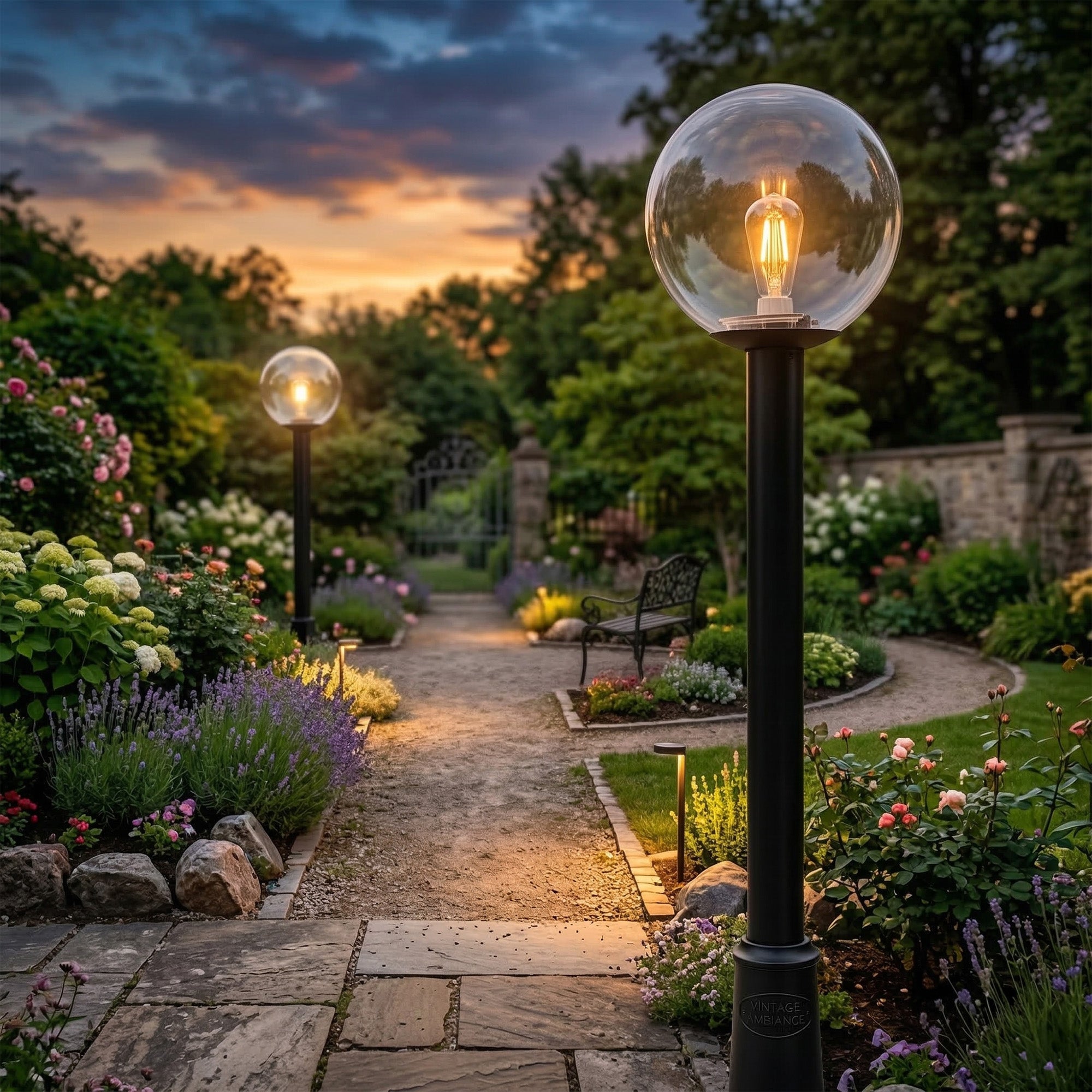
Globe-style fixtures mounted on posts provide 360-degree light distribution, which makes them ideal for pathway and perimeter lighting where light needs to spread in all directions rather than being aimed at one spot.
KASTLITE lamp post globes are available in sizes from 6 to 20 inches:
- 6-inch globes: Residential pathways, accent lighting
- 10-inch globes: Smaller walkways and garden paths
- 12-inch globes: Standard commercial pathways
- 16-inch globes: Wider coverage areas, parking perimeters
- 18-inch globes: Large commercial walkways and plazas
- 20-inch globes: Maximum coverage, park-style lighting
For complete installation solutions, check the pier mount lighting collection and globe combo kits that include the globe, fitter, and LED lamp in one package.
For Security and Flood Lighting
Parking lot corners, building entrances, and loading areas often need directed flood lighting rather than 360-degree globe distribution. KASTLITE offers:
- LED security lighting for building perimeters and dark zones
- Solar-powered flood lights for areas where running electrical conduit is impractical or too expensive
Glare Control: Why Uniformity Matters More Than Brightness
A common design mistake is over-lighting some areas while leaving others too dark. This creates "disability glare" when a driver's eyes adapt to a bright zone and then cannot see into an adjacent dark zone. The 20:1 uniformity ratio in IES RP-20 exists specifically to prevent this.
Techniques for Reducing Glare
- Use frosted or prismatic globes instead of clear lenses. Frosted globes scatter light over a wider angle, reducing the intensity from any single viewing direction. KASTLITE globes are available in clear, frosted, and prismatic finishes for exactly this purpose
- Shield the light source: Fixtures with full-cutoff or semi-cutoff shields direct light downward and prevent it from shining into drivers' eyes
- Lower mounting heights in pedestrian zones: A 10-foot pole with moderate output creates less glare than a 25-foot pole with high output, even if the ground-level illuminance is similar
- Choose warmer color temperatures: 3000K-4000K produces less perceived glare than 5000K+ cool white, while still providing adequate visibility
Energy Efficiency for Outdoor Lighting
Meeting IES standards does not mean high energy bills. Modern LED fixtures produce 120-150 lumens per watt, compared to 50-80 lumens per watt for older HPS (high-pressure sodium) and metal halide fixtures. That means you can hit the same foot-candle levels with 40-60% less energy.
For facilities looking to go further, solar-powered options eliminate electricity costs entirely:
- KASTLITE 45W Solar Barn Light (4,000 lumens): Powerful enough for parking lot perimeters and building facades. No wiring needed
- LED Solar Powered Flood Light: Motion-activated for entrances and security zones
- LED Bollard Path Light: Low-level pathway lighting for walkways and garden paths
Common Mistakes in Parking Lot and Pathway Lighting
- No uniformity plan: Installing fixtures without calculating spacing creates dark pockets that attract crime and cause accidents
- Over-lighting entrances, under-lighting the back of the lot: Every zone needs to meet minimum levels. The back row of a parking lot is where most vehicles are parked during peak times
- Ignoring vertical illuminance: Ground-level foot-candles mean nothing if security cameras cannot capture faces. Budget for vertical illuminance at 0.25 fc minimum in security areas
- Using non-outdoor-rated fixtures: Moisture ingress destroys fixtures within 1-2 years. All outdoor fixtures should be IP65 rated or higher
- Forgetting maintenance access: A 30-foot pole with a fixture that requires a bucket truck for lamp replacement will cost $300-500 per service call. Choose fixtures with long-life LED lamps (50,000+ hours) and accessible designs
Frequently Asked Questions
What foot-candle level is required for a parking lot?
IES RP-20 recommends 1.0 fc average for suburban parking lots and 1.5 fc for urban locations. Enhanced security areas should maintain 0.5 fc minimum with 15:1 uniformity. Your local building code may adopt these standards or set different minimums, so check local requirements as well.
How far apart should parking lot light poles be?
Spacing depends on pole height and fixture output. A general rule is to space poles no more than 4 times the mounting height apart. For a 20-foot pole, that means 80 feet maximum, though 50-70 feet is typical for achieving good uniformity.
Do parking lot lights need to meet ADA requirements?
The ADA does not set specific lighting levels, but accessible routes must be usable by people with visual impairments. Meeting IES pathway standards (0.5-2.0 fc for commercial walkways) generally satisfies the functional intent. Transitions between lit and unlit areas should be gradual rather than abrupt.
For more lighting guides, check these related articles:
For further reading, see the Federal Highway Administration roadway lighting standards.
- Smart Lighting for Small Businesses
- What Materials Last Longest for Outdoor Lighting Globes?
- How to Choose the Right Lamp Post Globe
- Best Acorn Style Light Globes
- Solar LED Bollard Light for Pathway Lighting
Related: On coastal projects, pathway and bollard lighting must also be turtle-safe. See what qualifies as turtle-friendly lighting and why artificial light threatens sea turtles.