
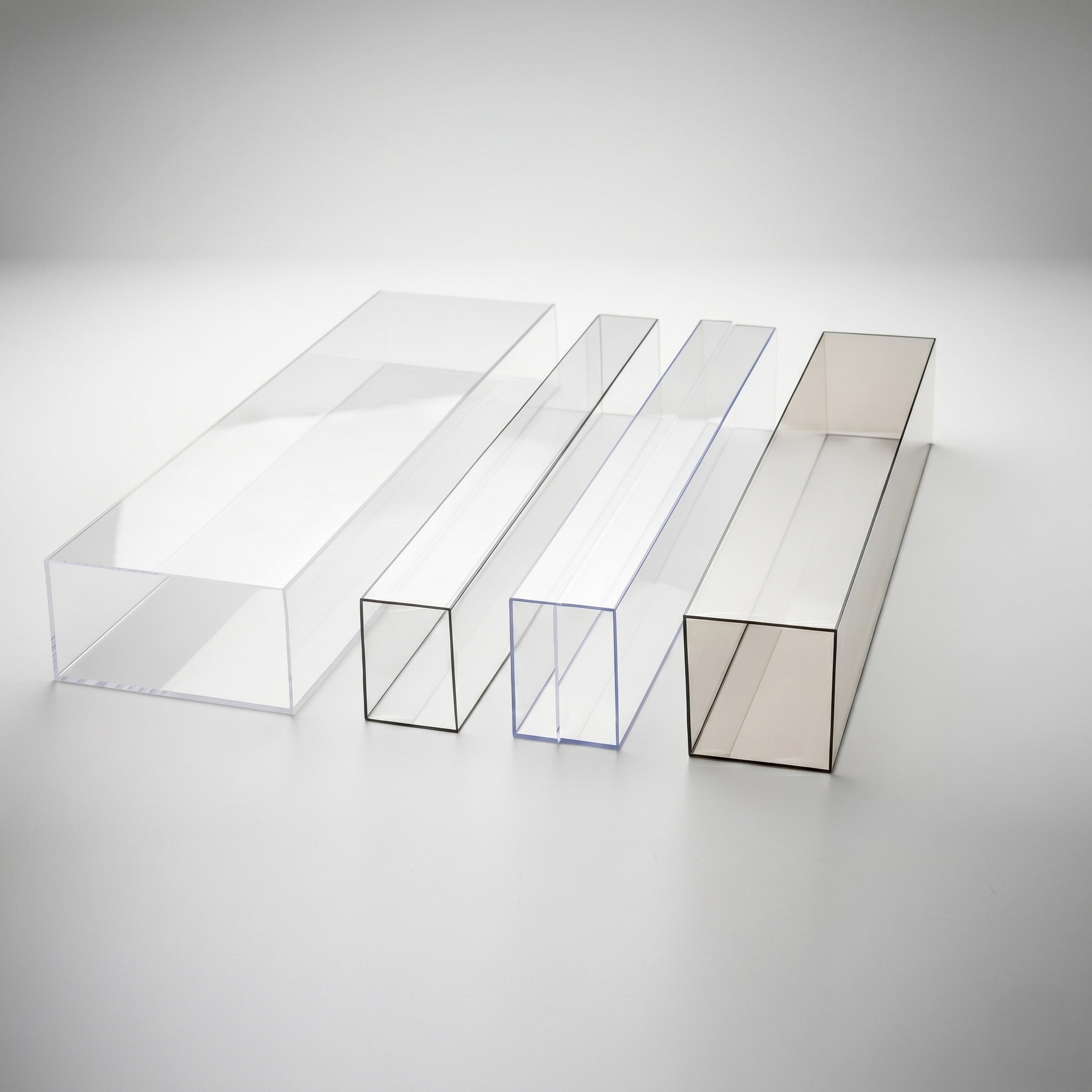
Five plastic sheet types dominate lighting, signage, and architectural projects: acrylic (PMMA), polycarbonate (PC), PETG, PVC, and ABS. Each material has distinct physical properties that determine where it performs best. This guide breaks down the specifications, ASTM test data, and real-world applications for every plastic sheet material KASTLITE sells so you can pick the right one for your next project.

Plastic Sheet Material Properties: Complete Comparison Chart
The table below compares the five most common plastic sheet materials across ten key properties. All values represent typical data for standard-grade sheets at nominal thickness (0.125 in / 3 mm). Actual values may vary by manufacturer and thickness.
| Property | Test Method | Acrylic (PMMA) | Polycarbonate (PC) | PETG | PVC (Rigid) | ABS |
|---|---|---|---|---|---|---|
| Tensile Strength | ASTM D638 | 10,500 psi | 9,500 psi | 7,500 psi | 7,500 psi | 6,500 psi |
| Izod Impact Strength (Notched) | ASTM D256 | 0.4 ft-lb/in | 12.0-16.0 ft-lb/in | No break / 1.5 ft-lb/in | 0.4-1.0 ft-lb/in | 5.0-8.0 ft-lb/in |
| Light Transmission | ASTM D1003 | 92% | 88% | 88-90% | 80-83% | Opaque |
| Heat Deflection Temp | ASTM D648 | 180°F (82°C) | 270°F (132°C) | 158°F (70°C) | 140°F (60°C) | 190°F (88°C) |
| Rockwell Hardness | ASTM D785 | M-95 | M-70 / R-118 | R-106 | R-110 | R-105 |
| UV Resistance | Outdoor exposure | Excellent | Good (with UV coating) | Fair | Poor | Poor |
| Chemical Resistance | ASTM D543 | Moderate | Moderate | Good | Excellent | Good |
| Flammability | UL 94 | HB | V-2 (some V-0) | HB | V-0 | HB (some V-0) |
| Water Absorption (24h) | ASTM D570 | 0.3% | 0.15% | 0.2% | 0.05% | 0.3% |
| Density | ASTM D792 | 1.19 g/cm³ | 1.20 g/cm³ | 1.27 g/cm³ | 1.40 g/cm³ | 1.05 g/cm³ |
How to Read This Guide: What Each Property Means for Your Project
Not every property matters for every job. If you are choosing a material for a lamp post globe or LED light cover, light transmission and UV resistance are the two numbers that matter most. If you need a machine guard or safety barrier, focus on impact strength and flammability rating. Here is what each metric tells you:
- Tensile strength (ASTM D638): How much pulling force the sheet can handle before it breaks. Higher numbers mean a stronger sheet.
- Izod impact strength (ASTM D256): How well the material absorbs a sudden hit without cracking. Polycarbonate dominates here at 12-16 ft-lb/in, while acrylic is brittle at 0.4 ft-lb/in.
- Light transmission (ASTM D1003): The percentage of visible light that passes through the sheet. Acrylic leads at 92%, matching optical-grade glass.
- Heat deflection temperature (ASTM D648): The temperature at which the sheet begins to soften under a 264 psi load. Polycarbonate handles 270°F, while PETG starts to flex at just 158°F.
- Rockwell hardness (ASTM D785): Scratch and wear resistance. Higher M or R scale values mean a harder surface.
- UV resistance: How well the sheet holds up to sunlight over months and years. Acrylic does not yellow. Polycarbonate needs a UV-stabilized coating. PVC and ABS degrade quickly outdoors.
- Chemical resistance (ASTM D543): Tolerance to solvents, acids, cleaning agents, and other chemicals. PVC is the clear winner here.
- Flammability (UL 94): Self-extinguishing behavior when exposed to flame. UL 94 V-0 is the highest rating (best). HB is the baseline (slowest burning).
Acrylic (PMMA) Sheet Properties
Acrylic, sold under brand names like Plexiglas, Lucite, and Optix, transmits 92% of visible light. That is more than standard glass. It is the go-to material for retail displays, picture framing, light fixtures, and signage where optical clarity is the top priority. Acrylic is also stocked in a full range of colored acrylic options, both transparent and opaque.
Acrylic comes in two forms: cast and extruded. Cast acrylic has tighter thickness tolerances (within 10% of nominal) and machines more cleanly. Extruded acrylic costs less and thermoforms at lower temperatures. KASTLITE carries both. For a deeper comparison, see our Cast vs. Extruded Acrylic guide.
Strengths:
- 92% light transmission per ASTM D1003, the highest of any common plastic sheet
- Does not yellow with UV exposure, even after years of outdoor use
- Lightweight: half the weight of glass at the same thickness
- Easy to laser cut, engrave, and solvent-weld for invisible joints
- Available in thicknesses from 0.040 in to 4 in
Limitations:
- Brittle under impact. A sharp blow will crack or shatter it rather than flex
- Izod impact strength of just 0.4 ft-lb/in per ASTM D256
- Softens at 180°F (82°C), limiting use near heat sources
- Sensitive to aromatic solvents like acetone and MEK
Common applications at KASTLITE: lamp post globes, light diffuser panels, LED light covers, retail display cases, protective sneeze guards, picture framing.
Polycarbonate (PC) Sheet Properties
Polycarbonate, known by brand names Lexan and Makrolon, is the strongest transparent plastic sheet available. It delivers 250 times the impact resistance of glass and 30 times the impact resistance of acrylic at the same thickness. It is the standard choice for safety glazing, machine guards, and any application where a sheet must survive heavy impact.
Polycarbonate also handles high heat: its heat deflection temperature reaches 270°F (132°C) per ASTM D648. That makes it suitable for lighting fixtures and enclosures near heat-producing equipment. For a detailed comparison with acrylic, see our Acrylic vs. Polycarbonate guide.
Strengths:
- Impact strength of 12-16 ft-lb/in per ASTM D256
- 88% light transmission per ASTM D1003
- Heat deflection at 270°F (132°C), highest among common transparent plastics
- UL 94 V-2 flammability rating (self-extinguishing)
- Can be cold-formed and bent without pre-heating
Limitations:
- Will yellow over time without a UV-stabilized coating
- Scratches more easily than acrylic. Abrasion-resistant coatings help but add cost
- Costs roughly 35% more than acrylic per square foot
- Sensitive to aromatic solvents, esters, and ketones
Common applications at KASTLITE: outdoor lamp post globes (high-wind areas), machine guards, security glazing, skylights, vandal-resistant light covers.
PETG Sheet Properties
PETG (polyethylene terephthalate glycol-modified) sits between acrylic and polycarbonate in both price and performance. It offers 88-90% light transmission, strong impact resistance (most PETG sheets score "no break" on the Izod notched impact test), and it thermoforms more easily than acrylic or polycarbonate.
Standard-grade PETG is made from FDA-approved resin, making it one of the few plastic sheet materials approved for direct food contact. That opens applications in food service, medical trays, and point-of-purchase displays.
Strengths:
- Strong impact resistance: absorbs about 70% of polycarbonate's impact energy
- 88-90% light transmission per ASTM D1003
- FDA-compliant for food contact applications
- Easiest of the five materials to thermoform (bends at lower temperatures)
- Does not yellow under UV exposure as quickly as polycarbonate
- Good chemical resistance to many common cleaners and solvents
Limitations:
- Lower heat tolerance: softens at 158°F (70°C) per ASTM D648
- Scratches more easily than acrylic
- Not recommended for extended outdoor use without UV stabilizers (3-5 year outdoor lifespan)
- Lower tensile strength than acrylic (7,500 vs. 10,500 psi)
Common applications at KASTLITE: light covers, retail signage, food service displays, vacuum-formed trays, protective barriers.
PVC (Polyvinyl Chloride) Sheet Properties
PVC is available in rigid and expanded (foam) forms. Rigid PVC has the best chemical resistance of any plastic on this list, making it the standard material for chemical tanks, fume hoods, and industrial equipment. Expanded PVC (Sintra, Komatex) is a lightweight foam board used in signage and displays.
Rigid PVC transmits about 80-83% of visible light in clear grades. That is lower than acrylic or polycarbonate, but enough for some indoor lighting and partition applications. Its real advantage is price: PVC is the least expensive plastic sheet material per square foot.
Strengths:
- Best chemical resistance: withstands acids, bases, and most solvents per ASTM D543
- UL 94 V-0 flammability rating (self-extinguishing, best possible rating)
- Lowest cost per square foot of any material on this list
- Low water absorption (0.05% per ASTM D570)
- Rigid PVC available in thicknesses from 0.020 in to 1 in
- Expanded PVC is lightweight and easy to cut, print, and mount
Limitations:
- Poor UV resistance: yellows and becomes brittle outdoors
- Low heat tolerance at 140°F (60°C), the lowest on this list
- Lower optical clarity than acrylic, polycarbonate, or PETG
- Can release hydrochloric acid fumes when heated above safe temperatures
Common applications at KASTLITE: chemical-resistant enclosures, industrial partitions, expanded PVC for signage and display boards, egg crate light panels.
ABS (Acrylonitrile Butadiene Styrene) Sheet Properties
ABS is an opaque thermoplastic known for its toughness, machinability, and low cost. Unlike the four materials above, ABS does not transmit light. It is the material behind most electronic enclosures, automotive trim, and prototype housings.
ABS machines cleanly, bonds well with adhesives, and paints easily without primer. Its Izod impact strength of 5-8 ft-lb/in per ASTM D256 puts it well above acrylic and PVC, though below polycarbonate. KASTLITE stocks ABS sheets in black and custom colors for projects that need a durable, opaque panel.
Strengths:
- Tough and impact-resistant at 5-8 ft-lb/in per ASTM D256
- Good dimensional stability: holds tight tolerances when machined
- Bonds well with adhesives and welds with acetone or MEK
- Lightest plastic on this list (density 1.05 g/cm³ per ASTM D792)
- Easy to sand, paint, and finish without primer
- Lower cost than polycarbonate or acrylic
Limitations:
- Opaque: no light transmission. Not suitable for lighting covers or windows
- Poor UV resistance: degrades and chalks outdoors without UV stabilizers
- Lower heat tolerance than polycarbonate (190°F / 88°C)
- Less chemical resistance than PVC or PETG
Common applications at KASTLITE: electronic enclosures, equipment housings, prototype parts, automotive trim, structural panels.

Application Guide: Which Plastic Sheet Is Best for Your Project?
The right material depends on what your project demands. Use the table below to match your application to the best plastic sheet option.
| Application | Best Choice | Runner-Up | Why |
|---|---|---|---|
| Lamp Post Globes | Acrylic | Polycarbonate | Acrylic delivers 92% light transmission and UV stability. Polycarbonate is better in high-wind or vandal-prone areas |
| LED Light Diffusers | Acrylic | PETG | Acrylic diffuses LED hot spots while maintaining high clarity. PETG offers better impact resistance at a lower cost |
| Fluorescent Light Covers | Acrylic | PETG | Acrylic has been the industry standard for ceiling light panels for over 50 years |
| Outdoor Signage | Polycarbonate | Acrylic | Polycarbonate survives hail, wind, and impacts. Acrylic is better for low-impact environments where clarity is the priority |
| Safety Glazing / Machine Guards | Polycarbonate | PETG | Polycarbonate is 250x stronger than glass. PETG works where chemical exposure is a concern |
| Skylights | Polycarbonate | Acrylic | Polycarbonate handles heat and impact. Add UV coating for yellowing protection |
| Food Service Displays | PETG | Acrylic | PETG is FDA-approved for direct food contact |
| Chemical Tanks / Fume Hoods | PVC | PETG | PVC resists acids, bases, and solvents better than any other option |
| Electronic Enclosures | ABS | PVC | ABS is tough, machinable, and holds tight dimensional tolerances |
| Egg Crate Light Panels | PVC | Polystyrene | PVC egg crates are durable and meet V-0 flammability requirements for commercial ceilings |

Understanding ASTM Standards for Plastic Sheets
ASTM International (formerly the American Society for Testing and Materials) develops standardized test methods so manufacturers and buyers can compare plastic sheet properties on equal terms. When you see a number like "ASTM D638," it refers to a specific, repeatable test procedure.
Here are the eight ASTM and UL standards referenced in this guide:
| Standard | What It Measures | Why It Matters |
|---|---|---|
| ASTM D638 | Tensile strength at yield | Tells you how much pulling force a sheet can handle before it deforms or breaks |
| ASTM D256 | Izod impact strength (notched) | Measures resistance to sudden impact. The most-cited spec for safety-critical applications |
| ASTM D1003 | Luminous transmittance and haze | Determines how much light passes through and how much scatters. Critical for lighting applications |
| ASTM D648 | Heat deflection temperature | Shows the temperature where a sheet begins to soften under load. Determines suitability near heat sources |
| ASTM D785 | Rockwell hardness | Indicates scratch and abrasion resistance. Important for high-traffic applications |
| ASTM D543 | Chemical resistance | Tests how plastics react to specific chemicals, solvents, and cleaning agents |
| ASTM D570 | Water absorption | Measures moisture uptake over 24 hours. Low values mean better performance in wet environments |
| UL 94 | Flammability rating | Rates self-extinguishing behavior. V-0 is the highest rating. Required by building codes for many applications |
When requesting a material data sheet (MDS) from any supplier, look for values tested to these standards. It is the only way to compare materials from different manufacturers on an equal basis.
Optical Properties for Lighting Design
For lighting projects, two numbers from ASTM D1003 matter most: luminous transmittance (total light passing through) and haze (light that scatters in all directions). A high transmittance with low haze produces a clear, see-through panel. A high transmittance with high haze produces a translucent, light-diffusing panel that hides LED hot spots.
Light transmission by material:
- Acrylic: 92% (clear), available in opal white with 50-60% transmittance for diffusion
- Polycarbonate: 88% (clear), available with light-diffusing additives for LED fixtures
- PETG: 88-90% (clear), common in vacuum-formed light panels
- PVC: 80-83% (clear grades only)
- ABS: 0% (opaque, not used for light transmission)
If your project needs to hide individual LED diodes while still spreading light evenly, choose a sheet with controlled haze. Acrylic light-diffusing panels (often labeled "opal" or "white") are the most common choice for troffer lenses, wrap-around light covers, and decorative pendants. Polycarbonate diffuser sheets work better when impact resistance is required, such as in gymnasium or warehouse ceiling fixtures.
KASTLITE carries both clear and diffusing grades of acrylic and polycarbonate sheets for lighting applications. Browse our light covers and diffusers collection or our plastic sheets collection to compare options.
Frequently Asked Questions
What is the strongest clear plastic sheet?
Polycarbonate. It delivers 12-16 ft-lb/in of Izod impact strength per ASTM D256, which is 250 times stronger than glass and 30 times stronger than acrylic at the same thickness.
Which plastic has the best light transmission?
Acrylic at 92% per ASTM D1003. That matches or exceeds most grades of optical glass. Polycarbonate and PETG follow at 88-90%.
Is PETG better than acrylic?
It depends on the application. PETG is tougher, easier to thermoform, and FDA-approved for food contact. Acrylic has better optical clarity, UV stability, and scratch resistance. For lighting applications, acrylic is usually the better choice. For food service or displays that need impact resistance, PETG wins.
Can I use PVC outdoors?
Not for long. Rigid PVC has poor UV resistance and will yellow, become brittle, and eventually crack with prolonged sun exposure. For outdoor applications, use acrylic or UV-coated polycarbonate instead.
What plastic sheet resists chemicals best?
Rigid PVC. It withstands most acids, bases, salts, and many organic solvents per ASTM D543. It is the standard material for chemical storage tanks and fume hoods.
Which plastic sheet is best for lamp post globes?
Acrylic is the standard choice for most lamp post globes because of its 92% light transmission and natural UV stability. In high-wind or vandal-prone areas, polycarbonate globes offer better impact resistance. KASTLITE sells both. See our globe sizing guide for help picking the right size.
What does UL 94 V-0 mean?
UL 94 is a flammability standard from Underwriters Laboratories. A V-0 rating means the material self-extinguishes within 10 seconds after the flame source is removed, with no burning drips. Building codes require V-0 or V-2 rated materials in many commercial lighting and construction applications.
What ASTM standard measures light transmission in plastic sheets?
ASTM D1003. It measures both luminous transmittance (total light passing through) and haze (scattered light). Material with a haze value above 30% is considered diffusing rather than transparent.
Choose the Right Plastic Sheet for Your Project
Every material on this list serves a specific set of applications. Acrylic leads in clarity and UV performance. Polycarbonate wins on impact strength and heat tolerance. PETG offers the best balance of formability and toughness. PVC handles chemicals and fire safety. ABS provides a tough, opaque option for housings and enclosures.
Ready to choose a thickness? Our plastic sheet thickness guide maps the right size for every material and application.
Ready to fabricate? See our guide to cutting polycarbonate sheets for blade, speed, and technique recommendations.
Replacing a light cover? Our measurement guide covers standard sizes and step-by-step instructions for every fixture type.
For a deep dive on one of the five materials, see our complete guide to PETG plastic.
If you are still unsure which material fits your project, our team can help. KASTLITE ships plastic sheets, lamp post globes, light covers, and diffuser panels across the United States. Browse our full plastic sheets collection or contact our team with your project specifications.
All data in this guide represents typical values for standard-grade commercial sheets. For project-critical specifications, request a material data sheet (MDS) for the specific product and thickness you are considering.