
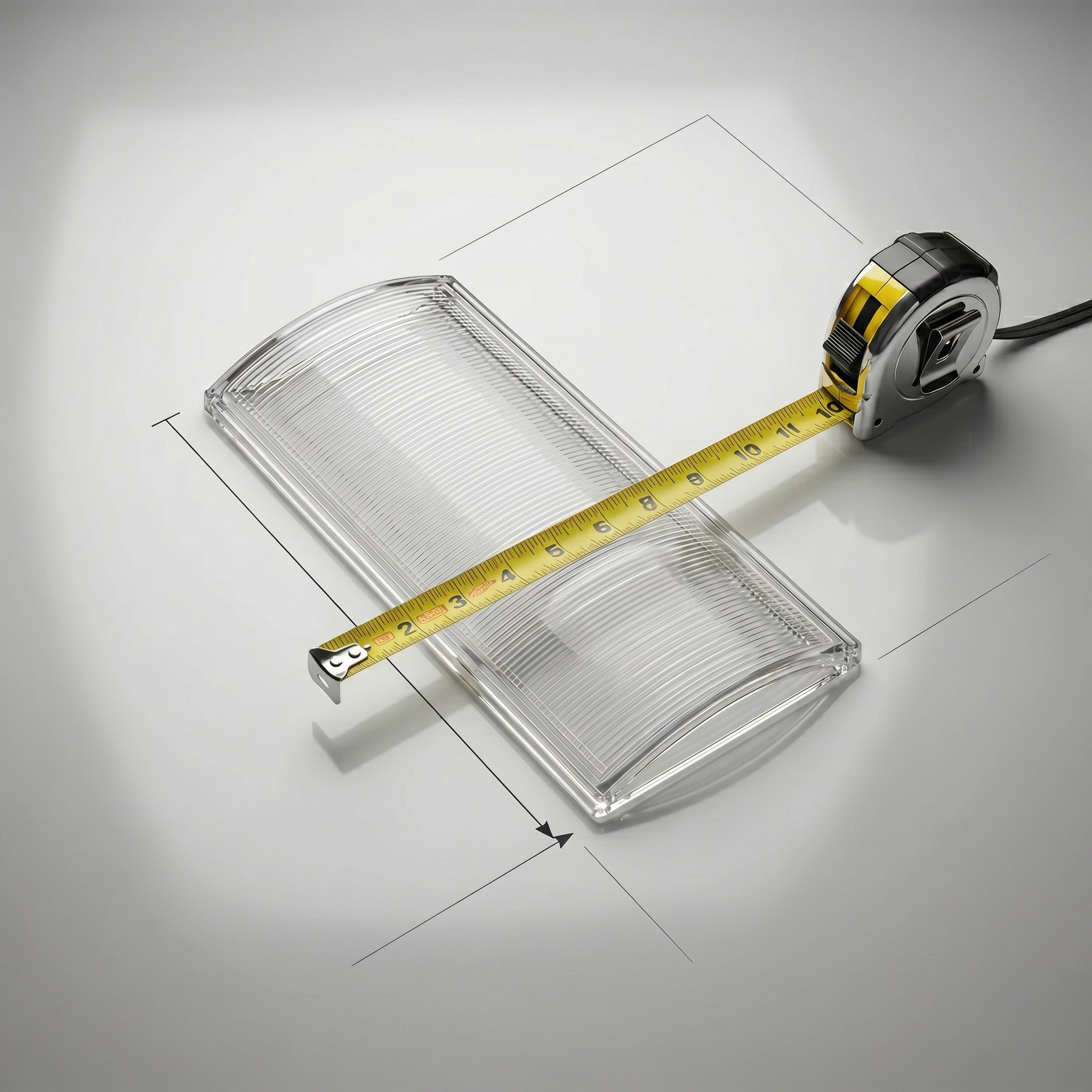
Ordering a replacement light cover that does not fit wastes money and delays your project. The fix is simple: measure the fixture, not the old cover. Old plastic warps, shrinks, and breaks unevenly, so taking dimensions from a damaged panel often gives you the wrong size. This guide walks you through how to measure every type of light cover KASTLITE sells, from flat drop ceiling panels to wraparound lenses to lamp post globes.

Standard Light Cover Sizes: Quick Reference
Before you grab a tape measure, check whether your fixture uses one of these standard sizes. Most commercial and residential ceiling light covers fall into a few common dimensions.
| Cover Type | Nominal Size | Actual Dimensions | Common Thickness |
|---|---|---|---|
| Drop ceiling flat panel | 2 ft x 4 ft | 23-3/4 in x 47-3/4 in | 1/8 in (3 mm) |
| Drop ceiling flat panel | 2 ft x 2 ft | 23-3/4 in x 23-3/4 in | 1/8 in (3 mm) |
| Drop ceiling flat panel | 1 ft x 4 ft | 11-3/4 in x 47-3/4 in | 1/8 in (3 mm) |
| Egg crate louver | 2 ft x 4 ft | 23-5/8 in x 47-5/8 in | 1/2 in cell depth |
| Egg crate louver | 2 ft x 2 ft | 23-5/8 in x 23-5/8 in | 1/2 in cell depth |
| Wraparound lens (4 ft) | 48 in length | 47-13/16 in (length varies by model) | Width and depth vary |
| Wraparound lens (2 ft) | 24 in length | 23-3/4 in (length varies by model) | Width and depth vary |
| T8 tube guard | 4 ft | 46-5/8 in x 1-1/4 in diameter | 0.040 in wall |
| T12 tube guard | 4 ft | 46-5/8 in x 1-5/8 in diameter | 0.040 in wall |
Nominal vs. actual: A "2 x 4" panel does not measure 24 x 48 inches. It measures 23-3/4 x 47-3/4 inches so it drops into the T-bar grid with a 1/8 inch gap on each side. Always confirm actual dimensions before ordering. If your fixture is not a standard T-bar grid, measure the fixture itself.
Tools You Need Before Measuring
- Tape measure (retractable, at least 6 ft)
- Pencil and notepad (or phone camera to photograph measurements)
- Step ladder (for ceiling fixtures out of reach)
- Digital calipers (optional, for precise thickness and fitter neck measurements)
- Flashlight (to see inside fixture housings)
Pro tip: Take a photo of the fixture with the cover removed and another with the cover in place. If you need help from our team, these two photos plus your measurements are enough to identify the right replacement.

How to Measure Flat Drop Ceiling Panels
Flat panels are the most common type of light cover. They sit in a suspended T-bar ceiling grid and cover fluorescent tubes or LED panel lights underneath. They come in three textures: prismatic (small pyramid pattern), smooth frosted, and cracked ice.
Step-by-step:
- Push the panel up and tilt it to remove it from the grid. Handle cracked panels with gloves
- Measure the length of the panel (the longer dimension). Standard is 47-3/4 inches for a 4 ft panel
- Measure the width (the shorter dimension). Standard is 23-3/4 inches for a 2 ft panel
- Measure the thickness. Most panels are 1/8 inch (0.100 in). Some older fixtures use thicker panels
- Note the texture: prismatic, frosted, or smooth clear
- If the panel is broken or warped, measure the grid opening instead. Subtract 1/4 inch from both length and width to get the correct panel size (this accounts for the 1/8 inch gap on each side)
Important: Measure the fixture, not just the old panel. Warped panels can measure up to 1/2 inch shorter or longer than the correct replacement size.
Browse KASTLITE's flat panel light covers in prismatic, frosted, and smooth finishes.
How to Measure Wraparound Lens Covers
Wraparound lenses curve around the bottom and sides of a surface-mounted fluorescent or LED fixture. They clip or hook onto the fixture's side channels. Wraparound covers are harder to measure than flat panels because you need three dimensions plus the attachment method.
Step-by-step:
- Remove the old lens by pressing inward on both ends and pulling down. Some lenses have clips or hooks at each end
- Measure the length from end to end. Most 4 ft wraparounds measure 47-13/16 inches, but lengths vary by manufacturer
- Measure the width at the widest point (the bottom of the curve). Then measure the width at the attachment hooks or clips. Record both numbers
- Measure the depth (height) from the flat mounting surface at the top to the lowest point of the curve
- Note the attachment type: snap-in clips, hook tabs, or friction fit
- Count the number of tubes (lites) the fixture holds. A "2-lite" wraparound is narrower than a "4-lite" wraparound
Pro tip: Wraparound lenses are the hardest light covers to size by measurement alone. If you cannot find an exact match, photograph the fixture from the front and side with a tape measure visible in the frame. Send the photos to our team and we can identify the correct replacement.
For a detailed look at one of the most popular sizes, see our article on the 48-inch wraparound lens replacement.
How to Measure Troffer Lenses and Baskets
A troffer is a recessed rectangular light fixture that sits inside the ceiling grid. The lens (flat or prismatic) drops into the troffer housing from below. Troffers are common in offices, schools, and hospitals.
Step-by-step:
- Open the troffer by releasing the latches on one side. The lens swings down on hinges or lifts out completely
- Measure the inside dimensions of the troffer housing (length and width). This is more accurate than measuring the lens itself
- Measure the lip (the ledge the lens sits on). The optimum overlap is 3/8 to 1/2 inch on all four sides. So the lens should be 3/4 to 1 inch larger than the light opening in both directions
- Measure the lens thickness. Standard is 0.100 inches (just under 1/8 inch) for acrylic prismatic
- Check whether the lens is flat or curved (some troffers use a slightly bowed lens for better light diffusion)
Common troffer sizes: 2 x 4 ft and 2 x 2 ft, same as drop ceiling panels. Many troffer lenses are interchangeable with standard flat panels if the lip dimensions match.
How to Measure Egg Crate Louver Panels
Egg crate panels (also called louvers or parabolic grids) are open-cell grids that reduce glare from fluorescent or LED lights while allowing airflow. They fit the same T-bar ceiling grid as flat panels.
Step-by-step:
- Remove the egg crate panel from the grid the same way you would a flat panel
- Measure length and width. Standard sizes match flat panels: 23-5/8 x 47-5/8 inches for a 2 x 4 grid
- Measure the cell size. Common cell sizes are 1/2 x 1/2 inch and 3/8 x 3/8 inch
- Measure the cell depth (how tall the grid walls are). Standard is 1/2 inch
- Note the material: PVC (white, silver) or polystyrene. KASTLITE egg crates are PVC with a UL 94 V-0 fire rating for commercial use
Browse our egg crate louver panels in standard sizes and colors.
How to Measure Tube Guards for Fluorescent and LED Bulbs
Tube guards are clear or colored sleeves that slide over fluorescent tubes or LED T8 replacements. They protect the bulb from breakage and contain glass if a tube shatters. They are required in food service and food processing areas per FDA Food Code requirements.
Step-by-step:
- Identify the bulb type: T5 (5/8 inch diameter), T8 (1 inch diameter), or T12 (1-1/2 inch diameter)
- Measure the bulb length. Standard lengths are 2 ft (24 in), 3 ft (36 in), 4 ft (48 in), and 8 ft (96 in). The tube guard should match the bulb length
- Check the end cap type: friction-fit caps, snap-on caps, or screw-lock caps. This determines compatibility with your fixture
Pro tip: If you are replacing fluorescent tubes with LED T8 tubes and keeping the tube guards, make sure the guard's internal diameter fits the LED tube. Most LED T8 tubes use the same G13 bi-pin base and 1 inch diameter as fluorescent T8s, so existing T8 guards work.
For more on tube protection, see our article on T8 safety sleeves.
How to Measure Lamp Post Globes
Lamp post globes require different measurements than ceiling light covers. The critical dimension is the fitter neck opening, which is the hole at the bottom of the globe that slides over the fixture post. If the fitter size is wrong, the globe will not attach.
Step-by-step:
- Measure the fitter neck opening (inside diameter of the bottom hole). Common fitter sizes are 3-1/4 in, 4 in, 5-1/4 in, 6 in, and 8 in
- Measure the globe height from the bottom of the neck to the top of the globe
- Measure the globe width at the widest point
- Note the globe shape: round, acorn, teardrop, or lantern
- Note the finish: clear, frosted/white, or smoke/tinted
For a complete guide to globe shapes, fitter types, and neck measurements, see our lamp post globe sizing guide. Browse our full selection of lamp post globes.

Common Measurement Mistakes and How to Avoid Them
- Measuring a warped panel: Old acrylic and polystyrene panels bow, shrink, and warp after years of heat exposure. Measure the fixture grid opening, not the old panel. Subtract 1/4 inch from both dimensions
- Confusing nominal and actual size: A "2 x 4" panel is NOT 24 x 48 inches. It is 23-3/4 x 47-3/4 inches. Ordering 24 x 48 gets you a panel that will not fit in the grid
- Forgetting the lip overlap on troffers: If you measure only the light opening (the hole the light shines through), the lens will be too small and fall through the frame. Add 3/4 to 1 inch to both length and width for proper lip coverage
- Measuring wraparound width at one point only: Wraparound lenses taper from the wide bottom curve to the narrow attachment hooks. You need both the widest width and the hook-to-hook width
- Wrong tube guard diameter: T8 and T12 tubes look similar but T12 is 50% wider. A T8 guard will not fit a T12 bulb. Check the marking printed on the end of the tube
- Mixing up globe fitter size and globe width: The fitter is the neck opening diameter. The globe width is the widest point of the sphere. These are different numbers and both matter for ordering
Frequently Asked Questions
What size light cover fits a standard 2 x 4 ceiling grid?
23-3/4 inches by 47-3/4 inches. This is the actual panel dimension, not the nominal 24 x 48 inch grid size. The 1/8 inch gap on each side lets the panel drop in and rest on the T-bar grid flanges.
Can I cut a light cover panel to a custom size?
Yes. Acrylic and polycarbonate panels cut cleanly with a circular saw or jigsaw and a fine-toothed blade. See our polycarbonate cutting guide for blade specs and step-by-step instructions.
How do I know if my panel is prismatic or frosted?
Hold the panel at an angle under a light. Prismatic panels have a grid of tiny pyramids or ridges on one side that scatter light in a specific pattern. Frosted panels have a smooth, milky-white finish that diffuses light evenly in all directions. Clear panels are fully transparent.
Are LED troffer lenses the same size as fluorescent troffer lenses?
In most cases, yes. LED retrofit troffers are designed to fit the same 2 x 2 and 2 x 4 ceiling openings as fluorescent troffers. The lens dimensions and lip overlap are typically identical. Measure the fixture to confirm.
What if my light cover is not a standard size?
Measure the fixture as described above, note all dimensions, and contact our team. KASTLITE can cut flat panels and egg crate grids to custom dimensions. For wraparound lenses, we can help match your measurements to the closest available replacement.
Which material is better for a replacement light cover: acrylic or polycarbonate?
Acrylic transmits 92% of light and does not yellow. It is the industry standard for most indoor ceiling fixtures. Polycarbonate is better for high-impact environments like gyms, warehouses, and schools where the cover might get hit. See our acrylic vs. polycarbonate comparison for a full breakdown.
Shop Replacement Light Covers, Cut to Your Size
Once you have your measurements, KASTLITE cuts acrylic, polycarbonate, and PETG covers to size in-house in Clearwater, Florida, so the panel fits your fixture the first time. The Amazon store holds a 4.6 out of 5 rating across more than 2,200 reviews.
- Browse all light covers and diffuser panels, standard sizes and custom-cut.
- Round lampshade diffusers for round and pendant fixtures.
Find the Right Replacement Light Cover at KASTLITE
Once you have your measurements, finding the right cover is straightforward. KASTLITE stocks flat panels, wraparound lenses, egg crate louvers, tube guards, and lamp post globes in all standard sizes. We ship across the United States.
For help matching your measurements to the right product, read our related guides:
PETG is a strong alternative to acrylic for light covers in high-impact environments. See our PETG guide for details.
- Material properties comparison (acrylic, polycarbonate, PETG specs)
- Thickness guide (how thick your cover should be)
- Do fluorescent light covers really work?
- What does a light diffuser do?
Browse our full light covers and diffusers collection or contact our team with your measurements for a custom match.
All dimensions listed are industry-standard values. Actual sizes may vary slightly by manufacturer. Always measure your specific fixture before ordering a replacement.